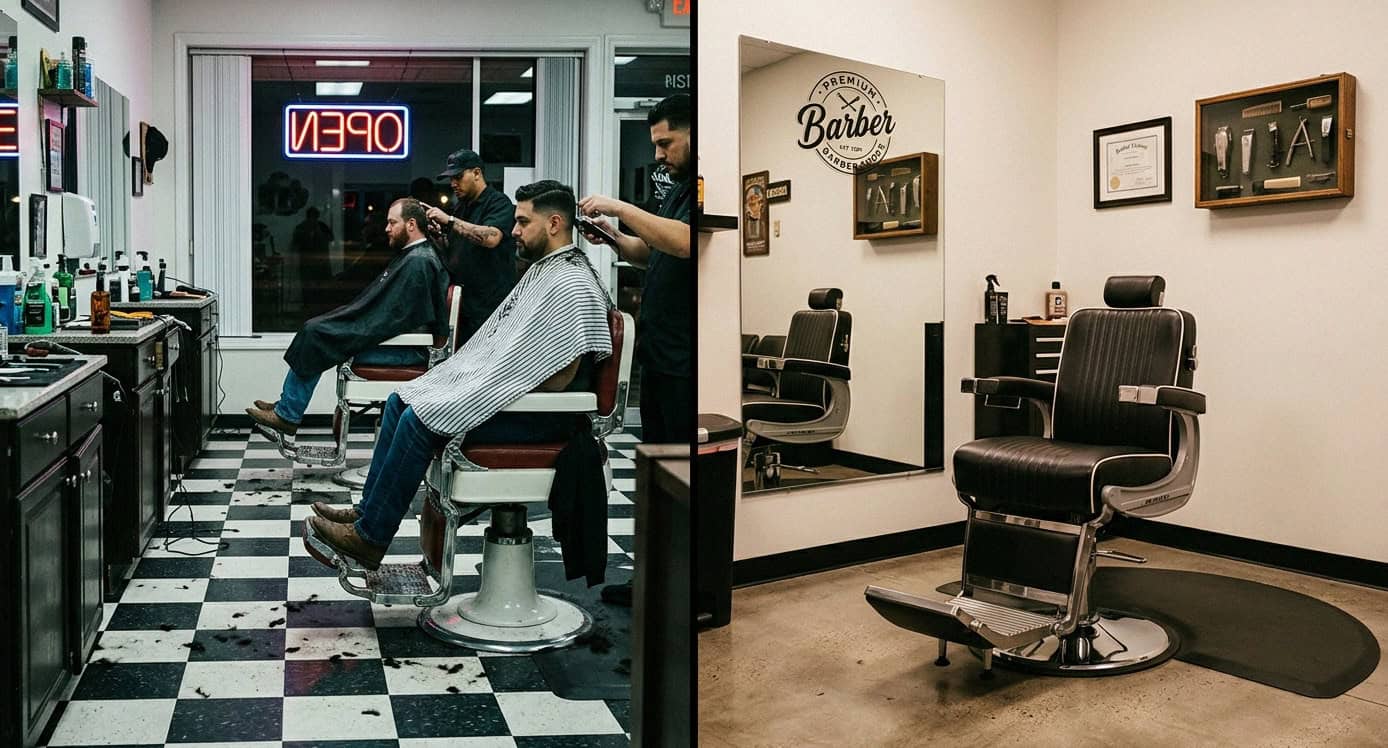
Booth rent is a flat weekly or monthly fee you pay a barbershop owner to use a chair. You keep all your service revenue, but you work in someone else’s space under their hours and rules. A salon suite is a private, lockable room you rent as a commercial tenant. You still pay a flat weekly fee, but you control your schedule, your pricing, your environment, and your branding.
In Texas, barber booth rent typically runs $150 to $400 per week depending on the shop’s location, traffic, and what is included. Booth rent at high-traffic barbershops in the Dallas-Frisco corridor commonly falls between $250 and $350 per week. A salon suite at Venus Salon Suites Frisco starts at $250 per week, all-inclusive, with introductory rate of $150 per week for the first 8 weeks.
The main structural difference: booth rent gives you a barber chair in a shared shop. A salon suite gives you a private space with a door that locks. On a $1,200 revenue week, both arrangements let you keep 100% of your service income after rent. The difference is what you are paying for and what you are getting in return.
Barber booth rent in Texas ranges from $150 to $400 per week. Here is what drives where you land in that range.
Smaller shops in secondary markets and suburbs tend to run $150 to $200 per week. High-traffic barbershops in metro-adjacent areas like Frisco, Plano, and the broader North Dallas corridor typically charge $250 to $350 per week. Premium locations in the DFW metroplex can reach $400 per week or more.
At $250 per week, you are paying $1,000 per month and $13,000 per year in barber booth rent alone. At $350 per week, that figure climbs to $18,200 per year before you buy a single pair of clippers or a bottle of product.
That weekly fee is where the cost story starts, not where it ends. Most booth rent arrangements in Texas do not include:
Some shops bundle these into the booth rent fee. Others charge them separately. The only way to know is to read the booth rent contract before you sign it. A chair rental advertised at $200 per week may cost $280 per week once you account for everything else.
The all-in annual cost of barber booth rent, once you include every expense, commonly runs $9,000 to $22,000 per year. That number matters when you start comparing it to what a salon suite costs.
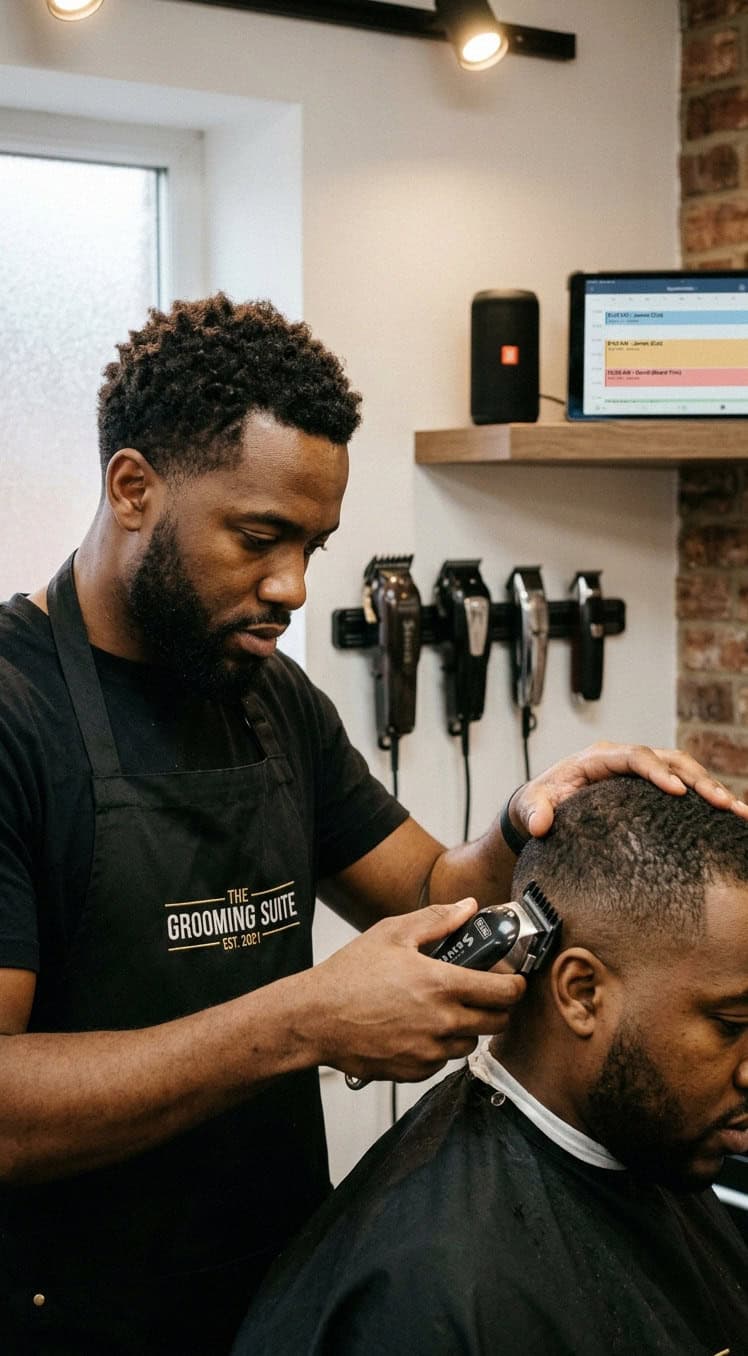
A suite at Venus Salon Suites Frisco is $250 per week, all-inclusive. That rate covers a fully equipped, barber-ready private space and every facility expense on top of it.
Pro Tip
If you are already doing 10 or more cuts per week at any price point in that table, you are covering rent and keeping money on top of it. Most barbers with a built client base hit break-even by Tuesday. introductory rate of $150 per week for the first 8 weeks drops that threshold even further during the transition period.
What the suite rate includes:
What you bring: your clippers, tools, products, and clients. That is it.
The all-in weekly cost is $250. Venus takes no percentage of your service revenue. If you have a $2,000 week, you pay $250 and keep the rest. If you have a $400 week, you pay $250 and keep the rest. Suite cost does not scale with your income, and it does not hide extras in a second bill.
Break-even calculation for independent barbers in Frisco:
At an average of $35 per haircut, you need 8 cuts to cover a week’s rent at Venus. At $40 per cut, you need 7 cuts. Most barbers with a built client base are covering rent by Tuesday.
| Avg. Cut Price | Cuts to Break Even | Weekly Revenue at 20 Cuts | Weekly Net After Rent |
|---|---|---|---|
| $30 | 9 cuts | $600 | $350 |
| $35 | 8 cuts | $700 | $450 |
| $40 | 7 cuts | $800 | $550 |
| $50 | 5 cuts | $1,000 | $750 |
Suite rent is the largest fixed cost, but it is not the only one. Managing quarterly estimated taxes as a 1099 independent contractor, product expenses, and tool depreciation all affect your net income. The guide on budgeting and tax planning as an independent barber covers the full picture of independent barber finances over a year.
The guide on setting your prices as an independent barber walks through how to price competitively in the Frisco market if you are not sure where to set your rates.
introductory rate of $150 per week for the first 8 weeksYour first-year cost depends on lease length and the current introductory terms. Call (972) 369-1127 for the current figure.
Can a barber make $10,000 a month from a salon suite? At $50 per cut and 5 cuts per day, 5 days a week, that is $5,000 per month in service revenue. Reaching $10,000 per month requires either higher pricing, product retail sales (which you keep 100% of in a suite), or adding specialty services. A barber suite in Frisco gives you the pricing freedom and product control that a booth in someone else’s shop does not.
Most independent barbers are deciding between these three arrangements at some point in their career. Each has a different cost structure and a different ceiling on how far you can build your business.
| Arrangement | Weekly Cost | Revenue Split | Schedule Control | Branding Control | Privacy |
|---|---|---|---|---|---|
| Commission (W-2 or 1099) | $0 | 40-60% to barber | Shop owner sets hours | Shop brand only | None |
| Barber Booth Rent | $150-$400 | 100% to barber | Mostly barber (shop hours apply) | Limited (shop rules apply) | Shared floor |
| Salon Suite (Venus Frisco) | $250/week all-in | 100% to barber | Full control | Full control | Private suite |
For a deeper look at the environment differences beyond cost, including foot traffic, culture, and career trajectory, see the barbershop vs. salon suite comparison.
Commission is the lowest-risk entry arrangement for a barber starting out. No fixed weekly cost means a slow week does not create a debt you have to dig out from under.
The trade-off is revenue retention. On a $1,000 revenue week at a 50/50 commission split, you earn $500 and the shop keeps $500. If you consistently generate $1,000 per week in services, you are paying the shop $2,000 per month. That is more than a $250 salon suite at $1,000 per month. The break-even point where commission costs more than a barber chair rental arrives faster than most barbers expect.
Commission works best when you are still building a clientele. Once you have 10 to 15 clients booking you consistently each week, the math usually shifts in favor of a rental arrangement.
Booth rent gives you full revenue retention above the flat weekly fee. If you cut 25 heads at $40 in a week, you keep $1,000 minus your booth rent, full stop.
The limitations are real: you are working within the shop’s hours, rules, and physical environment. If the shop opens at 9am, you open at 9am. Client scheduling happens on the shop’s terms. And if you leave, some barber booth rent contracts restrict your ability to contact the clients you built there through non-solicitation clauses.
Barber booth rent is not full independence. It is a step toward independence with a ceiling on how far you can go.
A private suite gives you a fixed cost, full revenue retention, complete schedule control, and a space that belongs to your brand. You set your hours. You set your prices. You choose your products. You build the environment your clients expect from you.
The cost difference between a $300 weekly booth and a $250 all-inclusive suite at Venus is often not the deciding factor. What you can do in a suite that you cannot do in a booth is the real comparison: take clients at 7pm or 7am, build a brand identity that follows you regardless of where you work next, and retain 100% of product retail sales in addition to service revenue.
A booth rent contract is a written agreement between you and the barbershop owner. It specifies the weekly or monthly rent amount, payment due date, what is included in the fee, shop operating expectations, and termination terms. Texas does not require a specific form for these agreements, but both parties should have a signed, dated copy.
Watch Out
Two clauses kill more barber exits than any other: non-solicitation language that locks you out of your own client list, and open-ended cancellation windows that require 60 or more days' notice before you can leave. Read both of these before you sign anything. If either clause is vague or missing, ask for clarification in writing.
A booth rent agreement is not a commercial lease. It is a license to use a barber chair. That distinction matters under Texas law: a commercial lease gives you documented tenancy rights. A booth rent contract gives the shop owner more flexibility to change terms or remove your access, with fewer legal protections on your end.
Before signing any booth rent agreement, review these clauses carefully:
| Contract Clause | What to Look For | Red Flag |
|---|---|---|
| Client ownership | Who owns client data and contact history | Any language giving the shop ownership of client relationships |
| Non-solicitation | Whether you can contact clients after leaving | Restrictions longer than 6-12 months |
| Cancellation notice | Days’ notice required before leaving | 60+ days notice puts you at a disadvantage |
| Rent escalation | Whether and how rent can increase mid-term | No cap on increases |
| Included services | Utilities, backbar, towels listed specifically | “Chair rental only” with no itemization |
| Subletting rights | Whether you can bring an assistant or apprentice | Silent on this if you plan to grow |
The red flags to prioritize: contracts with no defined cancellation window, no itemized list of included services, or any clause giving the shop ownership of client data you collected.
A salon suite lease at a licensed facility is a commercial tenancy agreement. It gives you documented rights to the space and no ambiguity about who controls your client relationships.
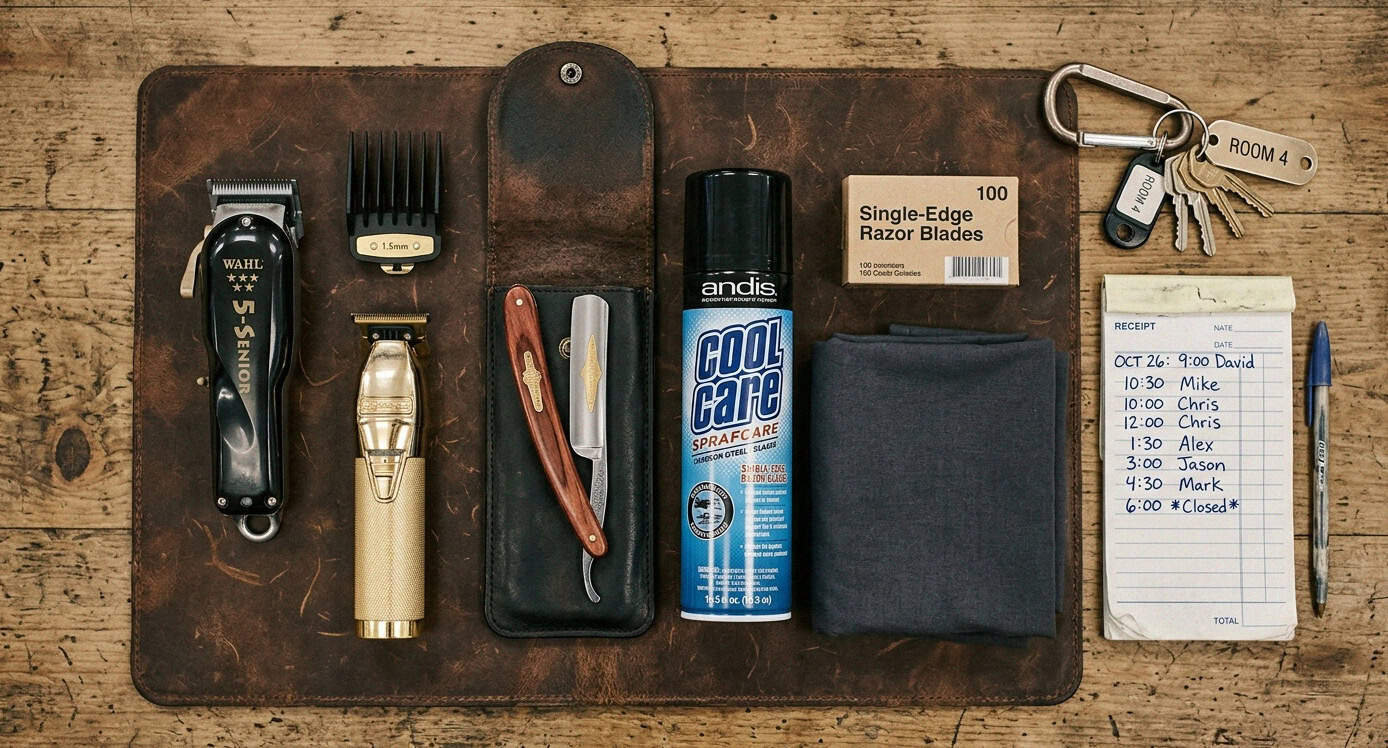
In Texas, every practicing barber must hold a valid license issued by the Texas Department of Licensing and Regulation (TDLR). The TDLR license requirement applies regardless of your work arrangement: commission, barber booth rent, or salon suite rental.
The standard working credential is the Class A Barber license. Initial TDLR licensure requires 1,500 hours of training from a TDLR-approved barbering school and passing both the written and practical Texas State Board exams. The Class A Barber license renews every two years, with six hours of continuing education required per renewal period. Verify current TDLR requirements at tdlr.texas.gov before relying on these figures.
Operating as an independent barber in a salon suite does not require any license beyond your individual Class A credential. You do not need to form an LLC to rent a suite, though many independent barbers in Frisco and the North Dallas area choose to for professional liability protection. The facility itself must hold a current TDLR barbershop or cosmetology facility permit. Venus Salon Suites Frisco maintains an active TDLR facility permit. Each tenant holds their own individual TDLR license.
One practical note for barbers making the transition to independent suite rental: TDLR renewal notices go to the email address on file with the agency. If that email is tied to a former employer’s domain or an address you no longer monitor, you may miss a renewal notice after you go independent. Before your move, log into the TDLR online portal and update your contact information. A lapsed TDLR license is the last thing you need on a Monday morning in your new suite.
Barbers in Texas typically pay $150 to $400 per week for booth rent, depending on the shop’s location and what is included. High-traffic barbershops in the Dallas-Frisco area and the North Dallas corridor commonly charge $250 to $350 per week. Most booth rent agreements require payment weekly in advance. The quoted fee usually covers the barber chair only. Utilities, backbar access, professional liability insurance, and booking tools are typically separate expenses.
The main disadvantages are fixed cost exposure and limited autonomy. You pay barber booth rent every week regardless of how many clients you saw. A slow week still comes with a full rent bill. Beyond cost, booth rental keeps you within the barbershop’s hours, rules, and physical environment. Client ownership is a separate concern: many booth rent contracts include non-solicitation clauses that restrict you from contacting your own clients if you leave the shop.
Profitability depends on client volume. A barber at Venus Salon Suites Frisco doing 15 haircuts per week at an average of $35 generates $525 per week in service revenue. After the $250 suite cost, gross margin is $275 per week before product costs, roughly 52%. A barber doing 25 cuts per week at $40 each earns $1,000 per week and keeps $750 after rent, a 75% gross margin. The suite arrangement becomes more profitable than barber booth rent once your weekly revenue exceeds the cost difference, which most barbers with an established client base reach within the first few weeks.
Neither is right for every barber at every stage. Commission suits barbers still building a clientele. No fixed weekly cost means a slow week creates no debt. Barber booth rent suits barbers with 10 to 15 or more steady clients who want to keep their full service revenue. The break-even point to watch: if your weekly commission payments consistently exceed what you would pay in barber booth rent, the math has already made the case for moving to a rental arrangement.
No separate business license is required to work in a licensed facility in Texas. Your individual TDLR Class A Barber license is what authorizes you to perform barbering services. You do not need to form an LLC to rent a barber suite, though many independent barbers choose to for liability protection. Confirm that the facility holds a current TDLR facility permit before signing. Venus Salon Suites Frisco maintains an active TDLR facility permit for all tenants.
Client portability depends on what your booth rent contract says. Many barber booth rent agreements do not restrict client contact after you leave. Some include non-solicitation clauses that do. Read your contract carefully before making any move. In practice, clients follow the barber when the relationship is strong. Building a client list with names, phone numbers, and booking history before you transition is the most important step you can take. The guide on keeping clients loyal through a suite transition covers how to build those relationships intentionally before you move.
The decision comes down to two variables: how many steady clients you have right now, and how much you are currently paying.
Ready to See It
See the suite, the equipment, and the facility before committing to anything. Tours are available at Venus Salon Suites Frisco, 15922 Eldorado Pkwy #100, Frisco, TX 75035.
If you have 10 or more clients booking you consistently each week and you are paying $250 or more in barber booth rent, a salon suite at Venus is likely a cost-neutral or cost-positive move. At that client volume, you are already covering a suite’s rent. What changes is what you get for it: a private space at 15922 Eldorado Pkwy in Frisco, full schedule control, your name on the door, and no restrictions on how you run your business.
If you are still building your client base and do not yet have 10 steady bookings per week, the lower-risk path is to stay in commission or a lower-cost booth arrangement while you grow. Going independent before your client volume supports it creates financial pressure that makes the whole transition harder.
Venus offers introductory rate of $150 per week for the first 8 weeks for barbers making this move. That covers the period when your volume may still be building and gives you a lower-cost window to reach steady-state without hitting full capacity on day one.
If a barber suite near Frisco is the direction you are heading, the next step is a tour. You will see the actual space, the included equipment, and the facility before committing to anything. Tours are available at Venus Salon Suites Frisco, 15922 Eldorado Pkwy #100, Frisco, TX 75035. Call (972) 369-1127 to schedule.
Once you decide to move forward, the step-by-step guide on how to make the transition from a barbershop to a suite covers the logistics in order: notifying your clients, setting up your online booking system, and preparing your space before opening day.
If you are not quite at 10 steady clients yet, the strategies in marketing yourself as an independent barber in Frisco are the fastest path to getting there.
Yes, barbers who operate their own suite and charge competitive prices routinely hit six figures. The math is straightforward: at $50 per haircut, you need 38 paid cuts per week across 52 weeks to reach $100,000 in gross service revenue. That works out to roughly 8 cuts per day, five days a week. Most barbers at capacity in a private suite handle 10 to 15 cuts per day. The variables that separate a $60,000 barber from a $100,000 barber are pricing confidence, client retention, and revenue diversification. In a salon suite, you keep 100% of every service and every product sale. Adding beard services, scalp treatments, and retail product sales at even modest volume can add $10,000 to $15,000 to annual revenue without increasing the number of heads you cut. The arrangement you work under directly affects your ceiling: a commission split means you surrender 40 to 60% of every dollar you earn, which makes six figures nearly impossible unless you are working at extremely high volume.
The right time is when you have 10 to 15 steady clients booking you each week and your current arrangement is costing you more than you are gaining from it. At that client volume, you are likely already covering a suite's rent. The financial break-even is easy to calculate: if you are paying $300 per week in booth rent and a suite costs $250 per week all-inclusive, you are already past it on cost alone. Beyond the math, there are two behavioral signals that say it is time. First, you are turning down clients because you cannot control your own schedule. Second, you are growing your reputation under someone else's shop name instead of your own. Those are not just frustrations. They are opportunity costs compounding against you every week you stay. The transition is lower-risk than most barbers expect, particularly when your existing client book transfers cleanly to the new location.
A booth rental gives you a chair in a shared barbershop. You pay a flat weekly fee to the shop owner and keep your service revenue, but you work within the shop's hours, environment, and rules. A barber suite is a private, lockable room in a professional facility. You are a commercial tenant with your own space, your own hours, and complete control over how you run your business. The physical difference is real: a booth is one station among several in an open floor plan. A suite is a separate room with a door that closes. That door changes the client experience, your pricing power, and your ability to build a brand that belongs to you rather than to the shop you happen to be working in. The cost difference in markets like Frisco is often smaller than barbers expect, particularly once you account for the add-on costs that booth rent agreements frequently leave out of the headline fee.
Not in a well-run facility. Venus Salon Suites Frisco has more than 30 independent professionals in the building across specialties: hair stylists, massage therapists, estheticians, nail technicians, and lash specialists. You have your own private suite, but you are operating inside an active professional community. That structure matters for two practical reasons. First, cross-referral traffic is real. A client who comes in for a haircut and meets an esthetician in the hallway is a referral your booth rent shop cannot capture for you. Second, the isolation concern that comes up in barber forums is mostly about transitions where a barber moves from a busy shared floor into a quiet private space. Venus's building traffic and tenant mix address that directly. You are not setting up a solo shop in a strip mall. You are joining an established community where the foot traffic and peer network already exist.
The most effective strategy starts before you open your suite. Tell every current client in person that you are moving and give them your new booking link directly. Do not rely on them finding you on their own. Send a personal text to every number in your contact list with your new location and a link to book the week you open. Social media is useful for reach, but direct personal contact converts at a much higher rate for service businesses. For net-new clients, your Google Business profile is the single strongest investment you can make in the first 90 days. A complete profile with real photos of your suite, your work, and your services will drive more organic inquiries than any paid advertising. Ask every satisfied client to leave a review. Five genuine reviews outperform a hundred followers. At Venus, tenants are listed in the building directory and benefit from the facility's local search presence, which gives you a visibility head start that a standalone independent barber does not have.
Confirm the equipment list before you sign anything. The suite should include a professional barber styling chair (not a generic salon chair), a shampoo bowl or backwash unit, a mirror, storage, and adequate lighting. Verify that utilities and WiFi are included in the weekly rate or understand exactly what is billed separately. Check for 24/7 access: if you take early-morning or late-evening clients, locked-hours access is a deal-breaker. Walk the facility and look at parking. A client who has to circle the lot for 10 minutes shows up frustrated. Ask about the TDLR facility permit: the facility must hold a current permit from the Texas Department of Licensing and Regulation for you to legally practice there. Ask whether you can see another barber's suite or a similar setup. Any reputable facility will accommodate that request. Finally, read the lease terms for the cancellation notice period. Sixty or more days' notice to exit is longer than it needs to be and puts you at a disadvantage if your circumstances change.