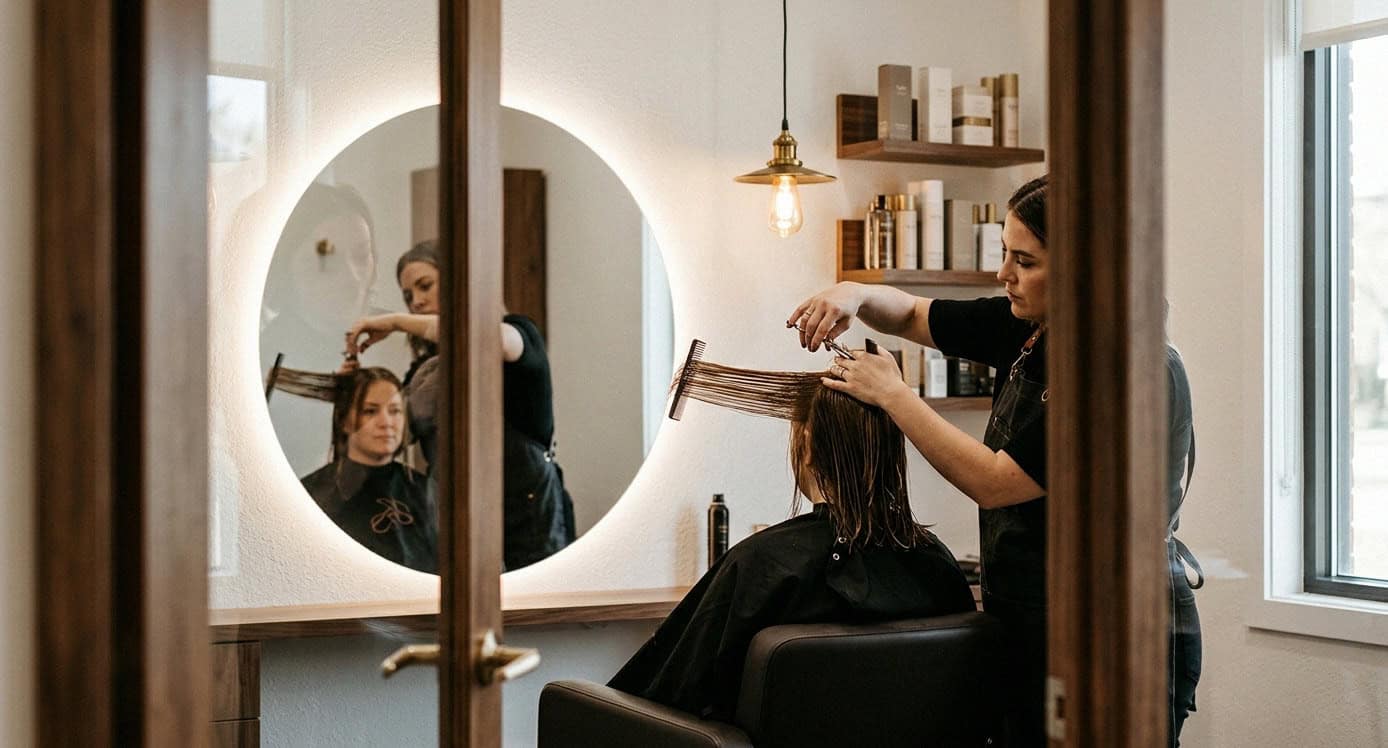
Renting a salon suite means leasing a private, lockable room inside a shared salon building and running it as your own business. You set your own hours, prices, and services, and you keep 100% of what you earn. Unlike booth rental, which puts you at a station on an open salon floor, suite rental gives you a fully private space with a door that closes. Weekly rates in Frisco, TX typically run $200-$350 all-inclusive, covering utilities, Wi-Fi, and standard styling equipment. At Venus Salon Suites Frisco, suites start at $250 per week. Stylists who come in with 30 or more regular clients generally break even or come out ahead within 90 days. The main risk is inconsistent income during the transition, not the business model itself.
A salon suite is a private, lockable room inside a professionally managed building. Your name is on the door. Your clients walk in, and no one else is in the space. You decide the hours, the music, the product lines, and the pricing.
That’s different from what most stylists are used to. In a commission salon, you work as an employee or independent contractor under someone else’s license, following their schedule, using their products, and splitting your revenue with the house. Booth rental is a step toward independence, but it still puts you on an open floor plan inside someone else’s salon. Your clients sit in a chair visible to everyone. The salon owner still sets the culture.
Suite rental is a different category entirely. You are the business owner. Your space is yours.
| Commission Salon | Booth Rental | Suite Rental | |
|---|---|---|---|
| Pay structure | 40-60% of services to stylist | Flat rent, stylist keeps 100% | Flat rent, stylist keeps 100% |
| Privacy | Open floor, shared space | Open floor, shared space | Private room, lockable door |
| Schedule control | Salon sets hours | Flexible but facility-dependent | Full control |
| Supply costs | Salon provides; limits your choices | Stylist pays, stylist chooses | Stylist pays, stylist chooses |
| Client ownership | Clients are technically salon clients | Clients are yours | Clients are yours |
All-inclusive suite rental means your weekly payment covers utilities (electricity, water, heating and cooling), high-speed Wi-Fi, parking, and typically a furnished station with a professional styling chair, mirror, shampoo bowl, and dryer. At Venus Salon Suites Frisco, all of that is included at $250 per week. You can see how that setup looks in our hair salon suites.
What all-inclusive does not cover: professional products, booking software subscriptions, and your own marketing costs. Ask any facility you tour to confirm exactly what is in the weekly rate and what is billed separately. The difference between a true all-inclusive model and a low advertised rate with add-ons can run $50-$100 more per month than the initial number suggests.
This is the section most stylists want to see, and most guides skip the actual numbers.
YOUR NUMBERS
Run the formula with your own service pricing. Take your average service ticket, divide it into $1,000 (four weeks at $250), and that's your monthly break-even client count. Most stylists transitioning with 25 or more regular clients hit that number in the first two weeks of the month.
Commission salons pay independent hair stylists between 40% and 60% of the services they perform. At a 50% commission split, a stylist who brings in $4,000 of client services in a month takes home $2,000. The salon keeps the other $2,000 to cover rent, products, utilities, and management costs. Tips usually go directly to the stylist.
Product sales are often split too, or go entirely to the house. If you upsell a client on a treatment or recommend a retail product, you may see very little of that revenue.
In a suite, you pay a flat weekly rate and keep everything else. Here’s a real scenario:
Fictional stylist: 30 clients per month, average service ticket of $120
| Commission Salon (50% split) | Suite at Venus ($250/week) | |
|---|---|---|
| Monthly gross revenue | $3,600 | $3,600 |
| Monthly cost | $0 direct (split taken from gross) | $1,000 (4 weeks x $250) |
| Monthly take-home | $1,800 | $2,600 |
| Difference | +$800/month in a suite |
The same 30 clients generating the same revenue leaves $800 more in your pocket each month in a suite than on a 50% commission split.
Retail product sales go entirely to you in a suite. A commission salon typically keeps 50% or more of product revenue. In your own suite, that full retail margin is yours to keep.
Before you sign a lease, run this formula:
(Weekly rent x 4) / Average service price = Clients needed to break even per month
For a Venus suite at $250/week and a $100 average service: > $1,000 / $100 = 10 clients per month to cover rent
That’s your floor. Everything above 10 clients per month is profit after rent. Most stylists who transition with 25-30 or more regular clients cover rent within the first two weeks of the month.
Getting the math right starts before you sign a lease. Pricing your services correctly affects your break-even point, your perceived value, and your ability to retain clients through any rate adjustments. Read how to set your service prices as an independent stylist for the frameworks stylists use to price confidently without undervaluing their work.
To rent and work independently in Texas, you must hold a valid cosmetology operator license issued by the Texas Department of Licensing and Regulation (TDLR). An apprentice permit is not sufficient for independent practice.
BEFORE YOU SIGN
Check your Texas cosmetology operator license status at tdlr.texas.gov before touring any suite facility. Renewing a lapsed license takes time you may not have if you're ready to move quickly. An apprentice permit does not qualify for independent suite operation.
Under Texas law, suite renters are classified similarly to booth renters: each stylist operates under their own individual license, while the suite facility maintains a separate establishment license. This means you are responsible for keeping your personal cosmetology license current, not the building owner.
Texas cosmetology operator licenses renew every two years and require four hours of continuing education per renewal period. The TDLR website at tdlr.texas.gov is the authoritative source for current requirements, renewal deadlines, and approved continuing education providers. Check your license status before you start the suite-rental process, not after.
A common question from stylists going independent is whether they need to form an LLC. Texas does not require an LLC to operate as a self-employed stylist. Many suite renters work as a sole proprietorship or file a DBA (doing business as) to operate under a business name. An LLC can provide personal liability protection, but that decision depends on your situation. An attorney or CPA familiar with Texas small business requirements can advise you based on your specific circumstances.
The short answer is yes, in most cases. Texas is an at-will employment state, and clients are not legally bound to a salon. They choose their stylist. Most clients, when told directly that their stylist is moving to a private suite, follow without hesitation.
The complication is your employment agreement. Many commission salon contracts include a non-solicitation clause that restricts how you can contact clients for a period after leaving. These clauses vary widely: some cover a geographic radius, some cover a time window, some cover only clients you saw in the last 90 days.
Check your current employment agreement before giving notice. If it includes a non-solicitation clause, consult an employment attorney before reaching out to clients directly. That consultation is worth the cost.
Practically, the most effective way to retain your client book is to communicate the move clearly and professionally. Announce on your social media. Send a personal message to your top 15-20 clients. Give them your new booking link and your new address in Frisco. Stylists who handle the client transition proactively keep the large majority of their existing book.
Building your client-facing social presence before the move makes a measurable difference. Your suite is private, which means clients can no longer walk by and see your work. Your social profile does that job instead. Stylists who build their independent brand on social media before their first day in the suite arrive with a booked calendar, not an empty one.
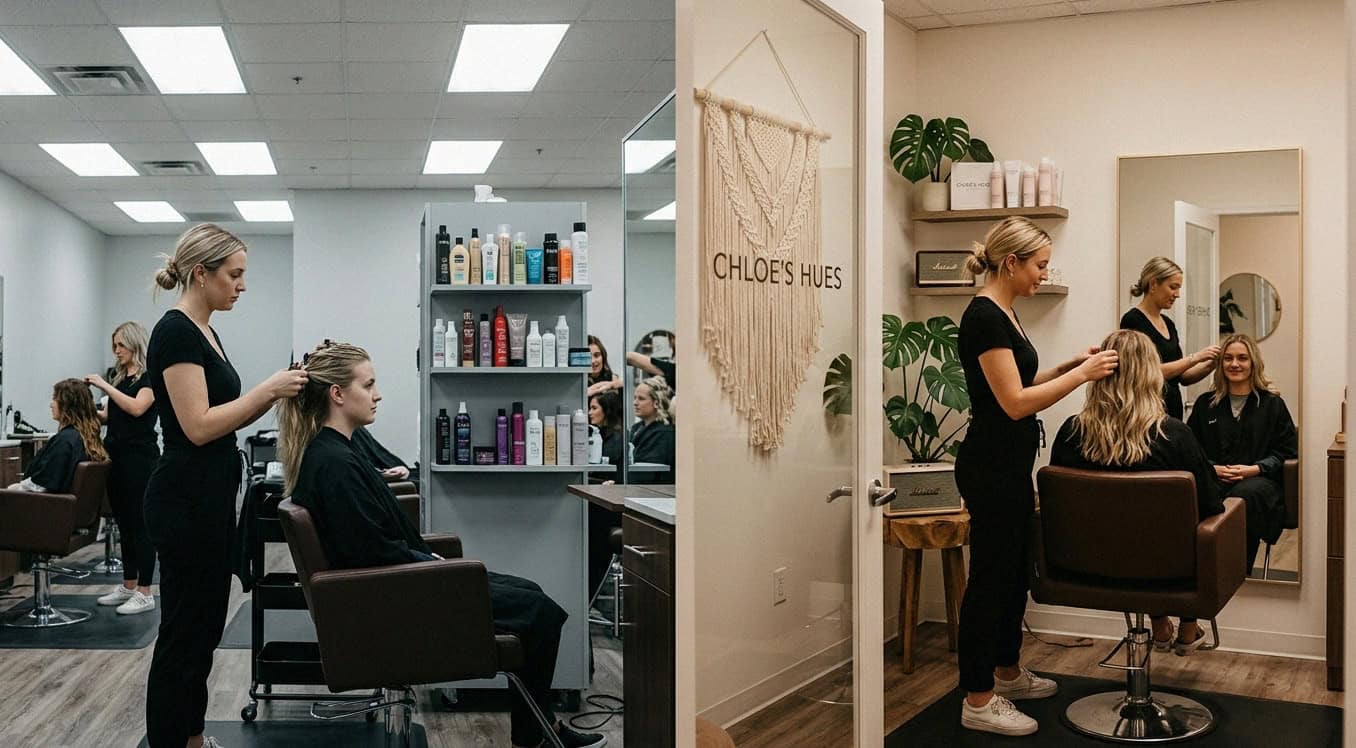
You control your schedule. You can close for a week, work Saturday mornings only, or book a full day. No one else sets your hours. Your service prices are yours: no salon mandate to stay at a certain price point or participate in promotions you did not choose. Your clients experience genuine privacy during consultations and treatments, which strengthens the one-on-one relationship that keeps a client book full. And the income math is straightforward: your gross revenue minus your flat weekly rent equals what you take home. Retail product markup, upsells, tips, all of it stays with you.
Venus Salon Suites Frisco has been operating in Frisco since 2012 with a community of 30-plus independent beauty and wellness professionals. That means you are not working in isolation. Hair stylists, estheticians, nail technicians, and massage therapists work in the same building, which creates a natural cross-referral environment that most independent stylists cannot replicate on their own.
Suite rental comes with real tradeoffs that most guides minimize. Your weekly rent is due whether you had a full book or a slow one. If you take two weeks off, you are still paying for those weeks unless your lease has a pause clause. There is no paid time off and no employer-sponsored health insurance. You handle your own product purchasing, which means cash out of pocket before any revenue comes in. Marketing, social media, and appointment booking software are now your responsibility and your expense.
Self-employed stylists are also responsible for quarterly estimated tax payments to the IRS. Setting aside 25-30% of income from each deposit covers federal self-employment tax and income tax for most independent stylists. The first 90 days involve more administrative work than most stylists expect, and that time comes out of your personal hours, not billable work hours. Stylists who come in expecting only the freedom and not the overhead have a harder first year.
This checklist is a self-assessment, not a sales pitch. Go through it honestly.
SEE THE SPACE
Venus Salon Suites Frisco offers low-pressure tours at 15922 Eldorado Pkwy #100, Frisco, TX. Walk the suite, see what's included, and ask any question you have. No commitment required. Call (972) 369-1127 or schedule online to set a time that works for you.
If you checked five or more of these, you have the foundation most stylists need to make the switch profitably. The checklist tells you if you are ready; understanding what the transition looks like in practice gives you the map for actually doing it. Read through what the first 30-60 days typically involve for stylists making the switch from commission to suite.
If you checked fewer than five, that is useful information too. The two items most often missing: client volume and savings. Work on those first. Signing a lease before your book is ready creates financial pressure that undermines the whole point.
If you are ready, the next step is seeing the space. Tours at Venus Salon Suites Frisco are low-pressure: walk the suite, ask questions, and decide if it fits your vision. Schedule a Tour

Stylists who build profitable suites quickly share a few consistent habits. They treat their space as a brand from day one, not a job. They price their services correctly from the start instead of discounting to attract clients. And they get the administrative side handled early, before it crowds out client time in month two.
Your suite is private, which means clients can no longer walk by and see your work. Your social profile does that job instead. Stylists who build their independent brand on social media before their first day in the suite arrive with a booked calendar, not an empty one.
Suite rental also removes the service constraints that some commission salons impose. If you were limited in the treatments you could offer, that restriction is gone. That flexibility only translates to revenue if your skills are current. Expanding your service menu is the starting point for stylists who want to add services without taking on client risk during the learning curve.
The most common first-year mistake is underpricing services to attract clients during the transition. It works in the short term and creates problems in the long term: clients anchor to the lower number, and raising prices later triggers friction you did not need. Set your prices at what your work is worth from day one. Price anchoring, service menu structure, and how to handle the “you used to charge less” conversation are all covered in the pricing strategy guide for independent stylists.
Three areas consistently catch first-time suite renters off guard: booking software setup, quarterly estimated tax payments, and product supply purchasing.
Get your booking system in place before your first client appointment in the new space. A dedicated booking tool for independent stylists lets clients self-schedule, sends automatic reminders, and reduces no-shows, all of which directly affect your break-even math.
Set aside 25-30% of your income from each deposit for quarterly estimated taxes. Self-employed stylists who skip this step face a painful catch-up in April. Open a separate business checking account to keep personal and business finances separate from your first week in the suite. Your supply costs will also run higher than expected in the first month as you stock the suite from scratch.
Retail product sales are a revenue layer that commission stylists often hand back to the salon. In your suite, that income is yours. Retail and upsell strategies for suite renters covers which approaches actually work in a private one-on-one setting and which feel forced.
Stylists with an established client book of 30 or more regular clients typically net more in a suite than on a commission split within 90 days. The math depends on your current split, your service prices, and the weekly suite cost. The business model works; the variable is how full your schedule is when you start. Stylists who transition with fewer than 20 regular clients often struggle in the first six months.
Booth rental means you lease a station inside an open salon floor plan and work among other stylists. A salon suite is a fully private, lockable room that you operate as your own business. Suite renters have more control over branding, client experience, hours, and service menu than booth renters.
The clearest signal is having 25-30 clients who request you by name with average service tickets above $80. Beyond client volume, you need enough savings to cover 2-3 months of rent and living expenses during the transition period. Review the readiness checklist in this guide for a full self-assessment.
No, an LLC is not required to rent a salon suite in Texas. Many stylists start as sole proprietors, sometimes filing a DBA (doing business as) to operate under a business name. An LLC can provide personal liability protection and may carry tax advantages once your income reaches certain levels. A CPA familiar with self-employed service businesses can advise on the right structure for your situation.
Yes. If you are self-employed, your weekly suite rent is a deductible business expense reported on Schedule C. Professional products, booking software subscriptions, continuing education costs, and general liability insurance premiums are also deductible. Keep receipts for all business expenses from day one in your suite.
In Texas, clients choose their stylist and are not legally bound to a salon. However, your employment agreement may include a non-solicitation clause that restricts how you contact clients for a period after leaving. Review your agreement before giving notice, and consult an employment attorney if it includes such a clause.
All-inclusive typically covers rent, utilities (electricity, water, heating and cooling), high-speed Wi-Fi, parking, and standard suite furnishings including a professional styling chair, mirror, and shampoo bowl. It does not cover professional products, booking software subscriptions, or marketing costs. Always confirm exactly what is included before signing a lease.
This guide covers the financial math, the Texas cosmetology license requirements, the realistic tradeoffs, and what the first 90 days actually look like for independent hair stylists. If you have read through it and the numbers make sense for where your book is right now, the logical next step is seeing the space.
Venus Salon Suites Frisco has been operating in Frisco, TX since 2012. The facility runs 33 suites, holds a 4.5-star rating across 80 Google reviews, and is home to 30-plus working professionals across hair, nail, skin, and wellness services. Suites start at $250 per week all-inclusive, with a introductory rate of $150 per week for the first 8 weeks.
Scheduling a tour takes two minutes. Walk the suite, see what is included, ask what you want to know, and decide from there. No commitment required.
Schedule a Tour at Venus Salon Suites Frisco or call (972) 369-1127.
Article by the Venus Salon Suites Frisco Team. Venus has operated salon suites in Frisco, TX since 2012, with 33 suites and a community of 30-plus independent beauty and wellness professionals.