Last verified: March 2026. Licensing requirements are set by TDLR and subject to change. Always confirm current requirements at TDLR.texas.gov.
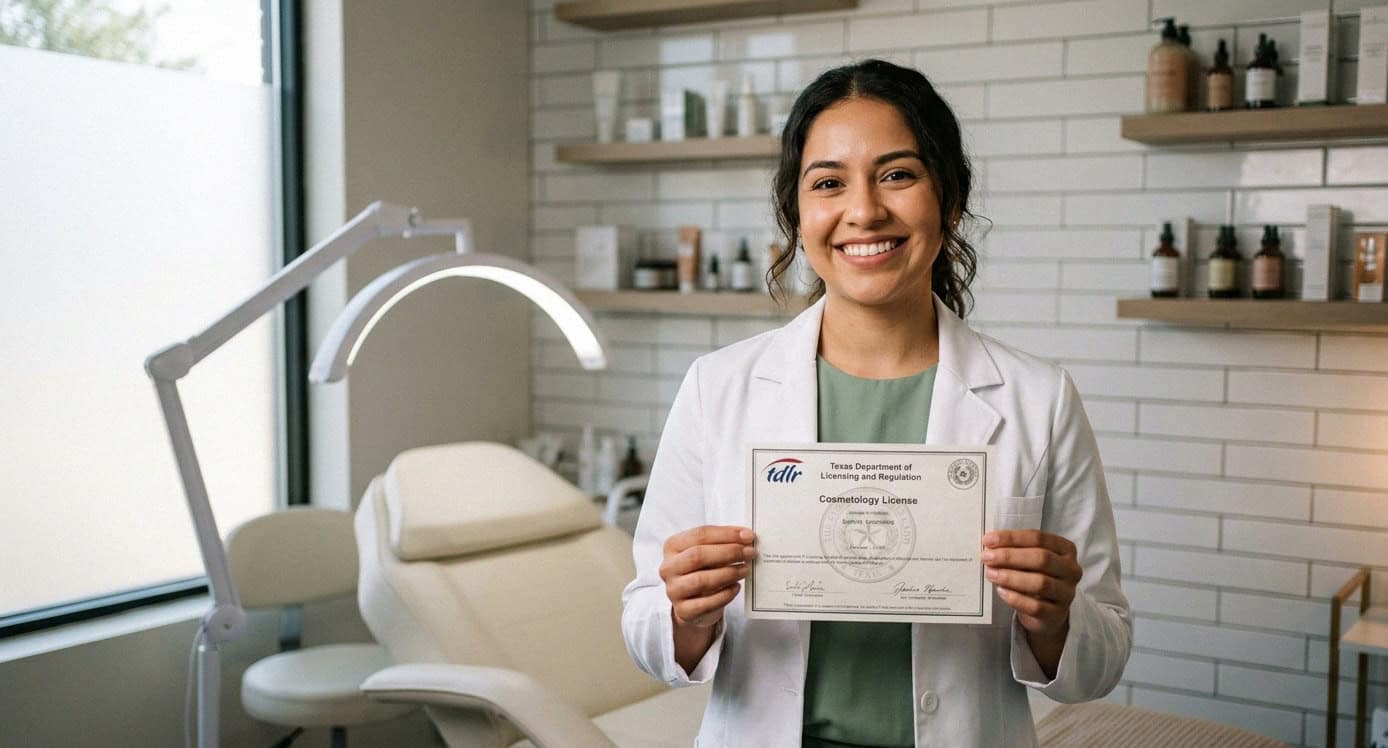
Getting a Texas esthetician license requires 750 hours of training at a TDLR-approved school, a passing score on the PSI licensing exam, and an approved application through the Texas Department of Licensing and Regulation (TDLR). Texas does not issue a separate waxing license. Waxing is included in the standard esthetician scope of practice. A Texas esthetician license is valid for 2 years and requires 4 hours of continuing education per renewal cycle.
TDLR, the Texas Department of Licensing and Regulation, is the state agency that issues and regulates esthetician licenses in Texas. Every step from training hours to renewal timeline is governed by TDLR rules, codified in the Texas Occupations Code.
The esthetician license and the cosmetology operator license are two separate TDLR credentials. A cosmetology operator license does not authorize the holder to perform esthetician services, and an esthetician license does not cover hair cutting or chemical hair services. If you want to provide skincare, facials, or waxing professionally in Texas, you need an esthetician license.
| Requirement | Details | Source |
|---|---|---|
| Training hours | 750 hours at a TDLR-approved school | TDLR.texas.gov |
| Minimum age | 17 years old | TDLR.texas.gov |
| Licensing exam | PSI (written and practical components) | TDLR.texas.gov |
| Issuing authority | Texas Department of Licensing and Regulation (TDLR) | TDLR.texas.gov |
| Application fee | $50 (non-refundable) | TDLR.texas.gov |
| License validity | 2 years from date of issue | TDLR.texas.gov |
| Renewal CE hours | 4 hours per renewal cycle | TDLR.texas.gov |
| Waxing license required? | No. Covered by the esthetician license. | TDLR.texas.gov |
Texas requires a minimum of 750 hours of instruction at a school licensed by TDLR. This baseline is set by state law and cannot be completed through an online-only program.
The 750 training hours prepare students for hands-on professional practice. A TDLR-approved esthetics program typically covers:
Full-time programs complete 750 hours in approximately 6 months, or around 30 weeks. Part-time schedules take 9-12 months depending on weekly attendance. Esthetics students in the North Texas area, including those near Frisco and Plano, can verify TDLR-approved school options directly at TDLR.texas.gov.
A common point of confusion: A Texas cosmetology operator license covers hair cutting, coloring, and chemical services. It does not authorize the holder to perform esthetician services such as facials, skincare treatments, or waxing. These are distinct TDLR credentials covering different scopes of practice. If you already hold a cosmetology license and want to add esthetics services, you apply for the esthetician license separately through TDLR.
TDLR also offers combination specialist licenses for students who want to hold multiple credentials. The manicurist/esthetician combination requires completing an 800-hour combined program, or the standard 750-hour esthetics program plus a 600-hour manicurist program. The hair weaving specialist/esthetician combination follows a similar structure.
What does esthetician school cost in Texas? Community college programs in the North Texas area typically run $7,000-$8,500 for the full 750-hour program. Private esthetics schools range from $8,000 to $20,000 depending on the institution and curriculum depth. The TDLR application fee of $50 applies on top of tuition.
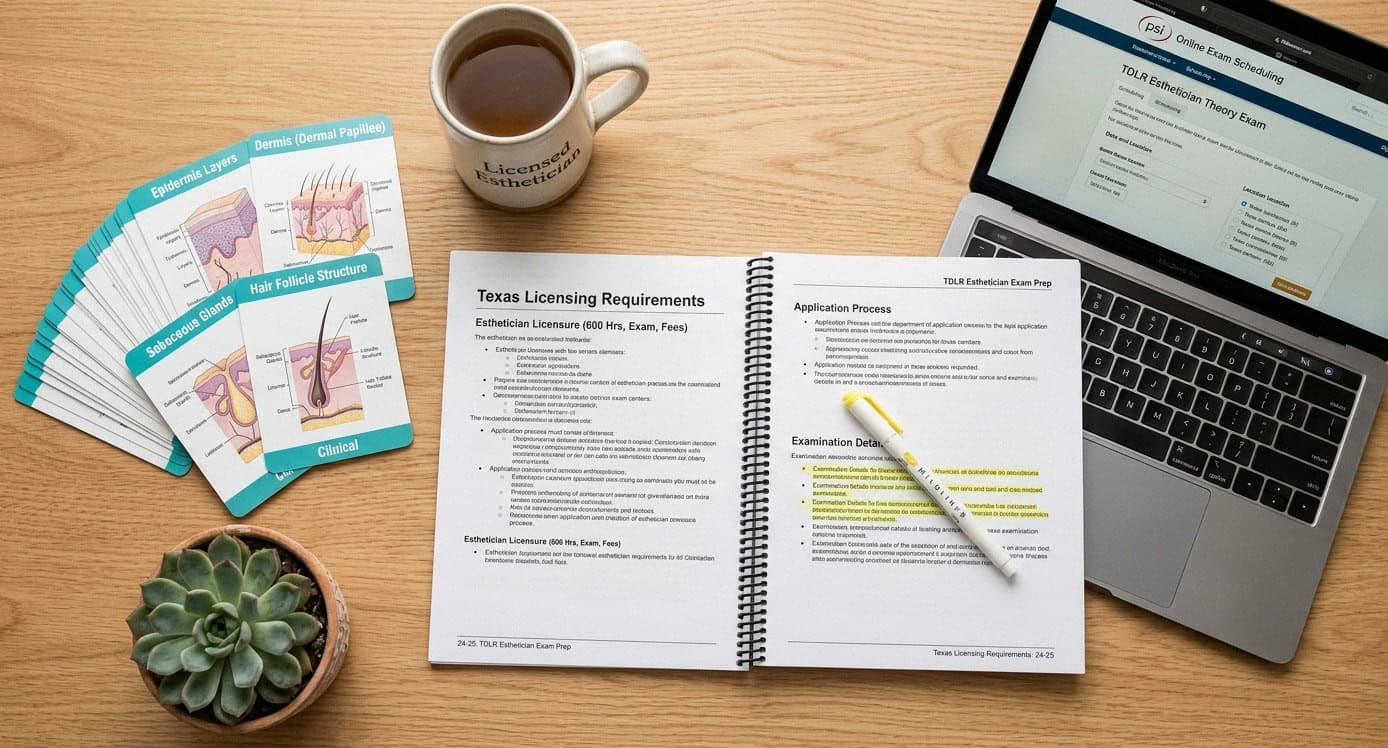
The TDLR application process for a Texas esthetician license follows a clear sequence. Here are the steps:
About the PSI exam: PSI is the third-party testing vendor that administers Texas esthetician licensing exams under contract with TDLR. The written portion covers skin care theory, sanitation protocols, product knowledge, and client safety. The practical portion requires you to demonstrate specific techniques in person. Your 750-hour program prepares you for both components.
About criminal history: TDLR may deny a license application based on certain criminal convictions. If you have a criminal history and want to know whether you are eligible before enrolling in school, TDLR allows applicants to request a pre-application determination. Contact TDLR directly for that process.
Realistic timeline: Full-time students typically complete 750 hours and receive a license within 6-9 months of starting school. Part-time students may take 12-18 months. After submitting your TDLR application, check the current processing time estimate at TDLR.texas.gov, as review times vary with application volume.
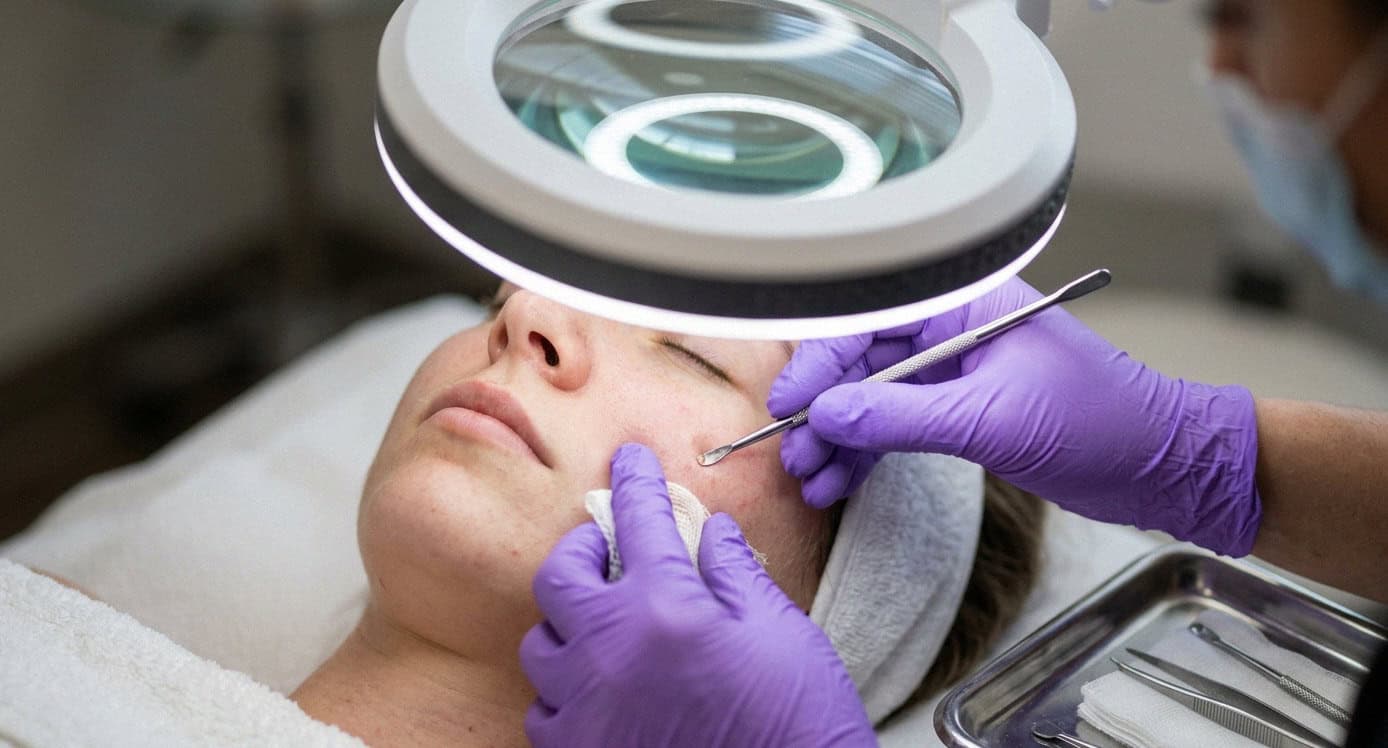
Your scope of practice defines exactly which services a licensed Texas esthetician is legally authorized to perform. TDLR sets these boundaries under the Texas Occupations Code, and understanding them is a professional and legal responsibility.
Licensed Texas estheticians are authorized to perform:
What falls outside the Texas esthetician scope of practice:
Important: Know Your Scope
Performing services outside your TDLR-authorized scope of practice puts your license at risk and exposes you to liability. When you work independently in a private suite, there is no employer or supervising physician between you and a client complaint. Review the TDLR scope-of-practice rules before adding any new service to your menu.
Can Texas estheticians perform chemical peels? Yes, within defined limits. Licensed estheticians in Texas can perform superficial chemical peels that act on the outermost layers of the skin. Peels that penetrate into living dermal tissue are classified as medical-grade procedures and fall outside the esthetician scope of practice. Building a chemical exfoliation menu around superficial peels keeps your practice compliant and your clients safe.
Scope clarity matters more when you work independently. In a private esthetician suite, your TDLR license is your only authorization. There is no supervising physician or salon owner absorbing liability on your behalf. Knowing exactly what your license covers protects both your business and your clients.
A Texas esthetician license issued by TDLR is valid for 2 years. Renewal requires completing 4 hours of continuing education (CE) during the renewal cycle.
The 4 CE hours break down into required categories:
Two exceptions apply. Estheticians who have held a Texas license for 15 or more years need only 2 CE hours per renewal cycle. Estheticians who are 65 or older and have held a Texas license for 15 or more years need only 1 CE hour. For everyone else, the 4-hour requirement applies regardless of experience level.
Qualifying CE types include:
TDLR-approved CE courses are available online in English, Spanish, and Vietnamese, which gives estheticians flexibility on how and when they complete the requirement.
Late renewal carries fees. At the point of expiration, the late renewal fee is $53. Beyond expiration, the fee increases to $79.50. Allowing a license to lapse for an extended period may trigger a reinstatement process that includes re-examination.
Set a calendar reminder 6 months before your expiration date. That lead time gives you space to complete CE, gather documentation, and process your renewal without rushing.
Pro Tip
Set two calendar reminders: one 6 months before your license expiration and one at 3 months. Use the 6-month mark to book your CE hours while availability is wide. Use the 3-month mark to submit your TDLR renewal application. Late fees start at $53 the day your license expires.
Always confirm current CE requirements and renewal fees at TDLR.texas.gov before renewing. Requirements are subject to legislative and regulatory changes.
If you hold an active esthetician license from another state and want to practice in Texas, TDLR offers a pathway called licensure by equivalence. This is sometimes referred to as the endorsement process.
The general eligibility standard requires that your home state’s training requirements be substantially equivalent to Texas’s 750-hour standard. If your state required fewer training hours, TDLR may require you to complete additional instruction before issuing a Texas license.
The licensure by equivalence route does not typically require you to retake the full PSI licensing exam, but verification is required at the time you apply. Out-of-state applicants use a separate TDLR application page distinct from the standard new-license process.
Because equivalence criteria and documentation requirements change, rely on TDLR.texas.gov for current eligibility standards rather than third-party summaries. The official TDLR page will have the most current information on required documents and processing timelines for out-of-state applicants.
No. Texas does not have a separate waxing license, a waxing technician credential, or a wax specialist license category under TDLR. This question comes up constantly among esthetics students, and the answer is consistent: no such credential exists in the Texas licensing system.
Waxing is included in the standard Texas esthetician scope of practice. A licensed esthetician in Texas can legally perform waxing services on any area of the body within that scope. No additional permit, credential, or specialty certification is required.
Do you need a license to wax in Texas? Yes. You need a Texas esthetician license. The path is straightforward: complete 750 hours at a TDLR-approved school and obtain your esthetician license. There is no shorter route or waxing-only credential.
The waxing license confusion is real and pervasive in esthetics circles. The answer does not require a separate document or credential. One license covers it.
Texas requires 750 hours of training at a TDLR-approved esthetics school. After completing those hours and receiving your school completion certificate, you submit your application through TDLR’s online portal and pass the PSI licensing exam before you can legally practice esthetics in Texas.
No. Texas does not have a separate waxing license. Waxing is fully included in the standard Texas esthetician license scope of practice, as defined by TDLR under the Texas Occupations Code. Any licensed esthetician in Texas can legally perform waxing services without any additional credential.
Yes, within a defined scope. Licensed Texas estheticians can perform superficial chemical peels that act on the outermost layers of the skin. Medical-grade peels that penetrate into living dermal tissue fall outside the esthetician scope of practice and require medical supervision. TDLR’s scope-of-practice page at TDLR.texas.gov defines these limits precisely.
Full-time programs typically complete the required 750 hours in approximately 6 months, or around 30 weeks. Part-time programs may take 9-12 months. After completing training, add TDLR application review time and PSI exam scheduling. Check TDLR.texas.gov for current processing time estimates before planning your timeline.
Yes, through TDLR’s licensure by equivalence process. Eligibility generally requires that your home state’s training standard is substantially equivalent to Texas’s 750-hour requirement. States with lower hour requirements may require additional training before TDLR issues a Texas license. Apply through TDLR.texas.gov for current endorsement criteria and required documentation.
No. A Texas esthetician license is its own separate TDLR credential. A cosmetology operator license covers hair cutting, coloring, and chemical services under the Texas Occupations Code. An esthetician license covers skincare, facials, waxing, and related services. The two licenses are distinct credentials for distinct service categories, and neither substitutes for the other.
Texas requires 4 hours of CE per 2-year renewal cycle. Required categories include 1 hour of sanitation and 1 hour of Human Trafficking awareness. The remaining 2 hours can be any TDLR-approved topic, including advanced techniques, infection control updates, or business training. TDLR-approved CE is available online in English, Spanish, and Vietnamese. Verify current requirements at TDLR.texas.gov.
PSI is the third-party vendor that administers Texas esthetician licensing exams under contract with TDLR. The exam includes written and practical components covering skin care techniques, sanitation protocols, product knowledge, and client safety. Both components must be passed before TDLR issues your license. After TDLR approves your application, PSI contacts you at the email address on file with scheduling instructions.
Ready to grow your esthetician business after licensure? Read our guides on building a reliable clientele as an independent esthetician, pricing your services as a self-employed esthetician, and time management for independent estheticians.
Getting a Texas esthetician license is the threshold. What you build with it is the decision that shapes your income and career for years afterward.
Most newly licensed estheticians in Frisco, Plano, and across North Texas face two primary paths after completing their TDLR requirements. The first is employment: working on commission or salary at an established salon or spa. In this model, the employer manages overhead, supplies, and client acquisition. You take home a percentage of what you produce, typically 40-60% after the commission split. Lower earning ceiling, but less to manage when starting out.
The second path is independence: renting your own esthetician suite and keeping 100% of what you earn. You set your hours, build your own service menu, price your work, and control every aspect of the client experience. The overhead is real, including rent, supplies, professional liability insurance, and marketing, but so is the income potential.
Ready to Work for Yourself?
Venus Salon Suites Frisco has private esthetician suites available on Eldorado Parkway. All-inclusive weekly rental starting at $250/week. No commission split. Your suite, your schedule, your income.
To operate independently as an esthetician in Texas, you need:
On the space question, the main options are a room rental inside an established salon, a private suite at a dedicated suite facility, or a home studio (subject to local zoning and ordinance rules). Each carries different cost structures, privacy levels, and client impressions.
Many estheticians in Frisco and the broader DFW metro choose the suite model because of what it delivers day-to-day: a private room that is entirely yours, the ability to set your service menu and pricing without asking permission, and a professional address without the overhead of a standalone commercial lease. The client experience inside a private esthetician suite is different from a shared salon floor. You control the sound, scent, lighting, and every detail of the appointment.
Venus Salon Suites Frisco offers private esthetician suites in Frisco TX starting at $250/week, with all utilities included. No commission split, no hidden fees. The facility has been operating since 2012, and the management team works alongside licensed estheticians at every stage of building an independent practice in North Texas.
If you are weighing your options after licensure and want to see what a private esthetician suite looks like in person, schedule a tour of our esthetician suites at our Frisco location on Eldorado Parkway. We’re happy to answer practical questions about what running your business from a suite actually looks like: costs, setup timeline, and what the first months as an independent practitioner tend to look like.
Your TDLR license is yours. The question is what you build with it.
No. Injecting Botox is a medical procedure in Texas and falls outside the esthetician scope of practice. Botox and dermal fillers require a medical license to administer. Licensed estheticians are not authorized to perform any injectable treatments, regardless of the setting or supervision arrangement.
This comes up often because estheticians who work in medical spas sometimes assist with pre- or post-treatment skincare. Assisting with skincare is not the same as injecting. The injections themselves are performed by physicians, nurse practitioners, or physician assistants. An esthetician in a medspa setting still operates within the standard TDLR esthetician scope of practice for their own services.
For most people who enter esthetics with a clear plan, yes. The license is a genuine business credential. It authorizes you to charge professionally for skincare, facials, waxing, and body treatments under your own name, and to operate independently or as an employee at a licensed facility.
Whether it pays off comes down to what you build after you receive it. Estheticians who work on commission at traditional salons typically keep 40-60% of service revenue. Estheticians who operate independently keep 100%. The $7,000-$20,000 school investment is fixed. Your income ceiling is not.
The license has a clear return when you treat the business seriously. It struggles when someone completes the 750 hours but does not actively build clientele or structure the work as a business.
Not fully. Texas requires 750 hours of hands-on instruction at a TDLR-approved school, and that training cannot be completed through an online-only program. The practical components of esthetics training, including facial techniques, waxing application, and chemical exfoliation, require in-person instruction at a licensed facility.
Some TDLR-approved programs offer blended formats where portions of the theory curriculum are delivered online, but the hands-on hours must be completed at a physical school location. Once you hold an active Texas esthetician license, continuing education for renewal is available fully online through TDLR-approved CE providers.
There is no separate TDLR medical esthetician license. All practicing estheticians in Texas hold the same state-issued esthetician license, regardless of whether they work in a spa, salon, or clinical setting.
"Medical esthetician" describes a career track, not a separate credential. Estheticians who work in medical spas or alongside physicians often pursue additional private training in clinical protocols, laser-adjacent skincare, or pre- and post-procedure skin preparation. That training comes through private certifications, not a second TDLR license. The foundation is the same 750-hour esthetician license that qualifies someone to work in a private suite or day spa.
None. Both spellings refer to the same profession. TDLR and most state licensing boards in the United States use "esthetician." The alternate spelling "aesthetician" appears in some trade publications and individual practitioner branding but refers to the same credential, scope of practice, and training requirements.
When referencing your Texas license or searching the TDLR portal, use "esthetician." That is the spelling TDLR uses in all official documentation, exam materials, and the licensing application.
Yes. A valid TDLR esthetician license allows you to operate independently. Texas does not require estheticians to be employed by or affiliated with a licensed salon. You can rent a private esthetician suite, work from a licensed home studio (subject to local zoning rules), or lease commercial space on your own.
Independent practice requires a few things beyond the license: a workspace that meets TDLR sanitation requirements, professional liability insurance, and a business structure. Most estheticians start as sole proprietors. Many in the Frisco and North Texas area choose a private suite rental because it provides a compliant, fully-equipped workspace without the overhead or commitment of a standalone commercial lease.