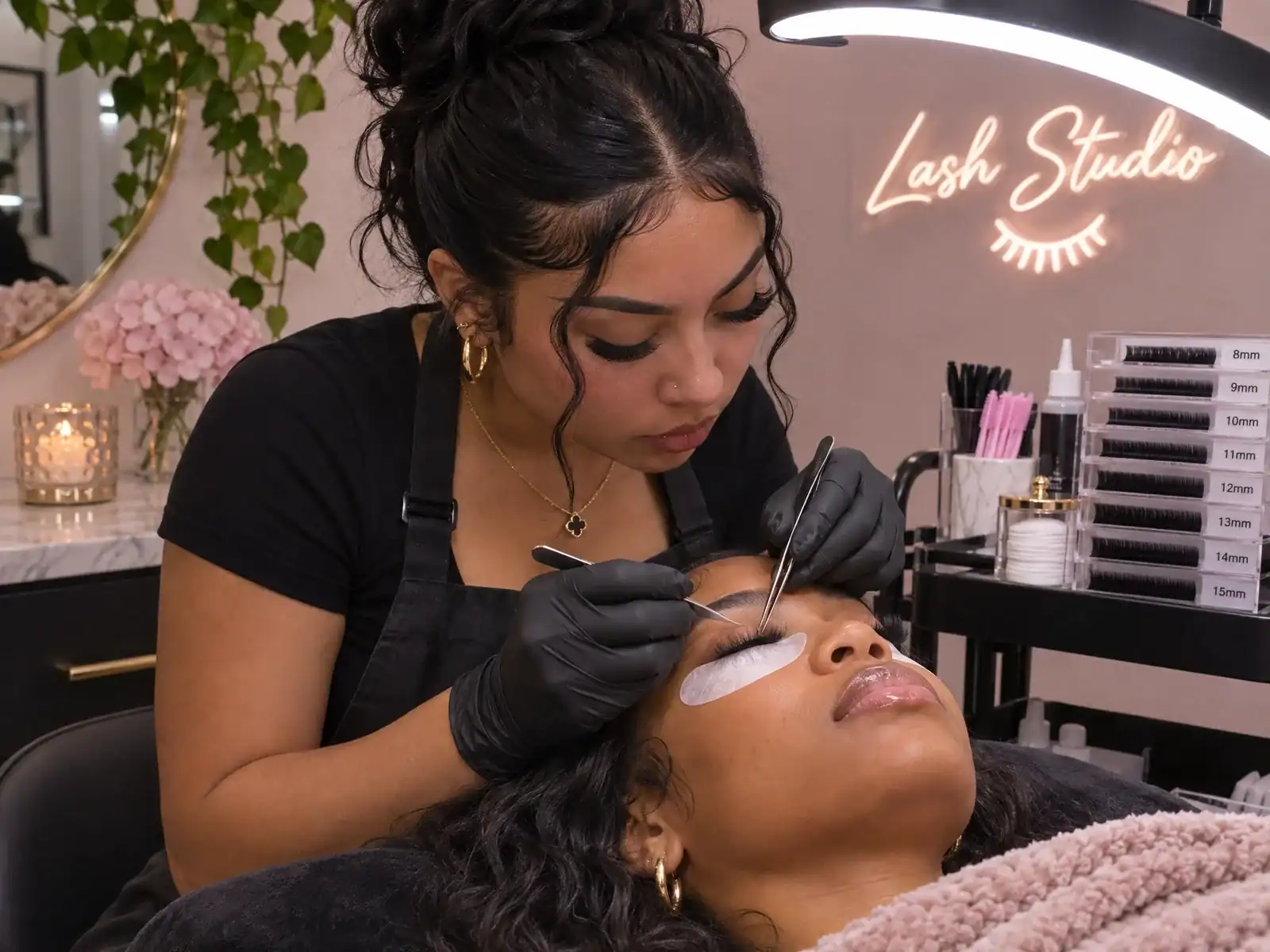
To become a lash tech in Texas, you need a license from TDLR, the Texas Department of Licensing and Regulation. The focused route is the Eyelash Extension Specialist license: 320 hours at a licensed school, then a written exam and a practical exam. The esthetician license, the cosmetology operator license and the two combination licenses (manicurist/esthetician and hair weaving specialist/esthetician) also cover lash extensions, along with additional services.
A certificate from a private lash course is not a Texas license, so it doesn’t let you charge clients for lash work. The eyelash extension license covers extensions only, and hours, exams and fees can change, so check TDLR’s Eyelash Extension Specialist application page for current requirements before you pay for anything. The six steps below run in order, from choosing a license to working for yourself in a private suite.
Five Texas licenses cover applying eyelash extensions, and the Eyelash Extension Specialist license is the focused route. Texas law treats lash extensions as part of cosmetology, and the five licenses are the Eyelash Extension Specialist, esthetician, cosmetology operator, manicurist/esthetician and hair weaving specialist/esthetician licenses. TDLR’s scope of practice page for lash extensions and Texas Occupations Code Chapter 1603 both name all five. Some TDLR summary pages list only three of them, and the statute is the version to go by.
Verify With TDLR
Rules, hours and fees are set by TDLR and can change, so before you enroll, apply or offer a service, confirm the current requirements for your license with the Texas Department of Licensing and Regulation. This guide was checked against TDLR's pages and the Texas Occupations Code as of November 2026. This is not legal advice.
The specialist license takes 320 hours at a licensed school and covers lash extensions only. The esthetician license takes 750 hours, and the two combination licenses take 800, with lash extension application included in each curriculum. Choose the specialist license if lash extensions are your whole menu. Consider a longer license if you also want to offer services the specialist license leaves out, such as body hair removal, which TDLR lists as outside the specialist license.
If you already hold an esthetician, cosmetology operator or combination license, that license already covers lash extensions, and the school and exam steps below are ones you’ve been through for it. Skip ahead to Steps 5 and 6. A Class A barber, manicurist or hair weaving specialist license on its own doesn’t cover lash extensions, so holders of those licenses still need one of the five.
A private lash course certificate doesn’t authorize paid lash work in Texas, because Texas law says nobody may perform an act of cosmetology unless they hold a license or permit issued by TDLR. A course can still teach you technique, but the license is what lets you charge for it. The path to that license runs through a licensed school, which is Step 3.
The Eyelash Extension Specialist license covers applying semipermanent, thread-like extensions to a person’s eyelashes and no other barbering or cosmetology service. That’s TDLR’s wording on its scope page, so your menu has to stay inside the services that page lists.
TDLR’s list of services outside the specialist license includes facials, body hair removal, hair services and nail treatments. TDLR describes body hair removal as using depilatories, preparations or chemicals, tweezers or other devices, and it is outside the specialist license, so confirm with TDLR before you add brow waxing or tweezing. Brow lamination isn’t covered either. TDLR’s published service guide names the cosmetology operator, esthetician, Class A barber, manicurist/esthetician and hair weaving/esthetician licenses for that service, and the specialist license isn’t on the list. The same page of limits covers what a specialist can advertise as well as what a specialist can perform, so check your menu and your social posts against it.
Lash lifts, lash perms, lash tinting and brow tinting are a gray area. None of the TDLR pages checked for this guide says which license covers them. The specialist license covers extensions only, so confirm with TDLR which license applies before you add any of these services to your menu.
Strip lashes need no license in Texas. Microblading falls under the Texas Department of State Health Services and the Texas Medical Board, and permanent makeup falls under the Texas Department of State Health Services, so ask those agencies if either is on your plan.
To apply for the Eyelash Extension Specialist license, you must first complete a 320-hour Eyelash Extension Specialist course at a licensed school, a requirement TDLR sets.
A student permit is issued while you’re enrolled and in training. The student permit is a separate document from the license, and TDLR says to complete the 320 hours before you apply for the Eyelash Extension Specialist license.
If you trained outside Texas, TDLR has a separate page for applying for a license by equivalence, and that’s where to start.
One piece of advice that isn’t a TDLR rule: ask any school for its full cost in writing before you enroll, so you can compare options on the same terms.
You apply through TDLR, clear a background check, and pass a written exam and then a practical exam before you start work. You must be at least 17 to apply, and the application fee is $50 and non-refundable. TDLR’s application page is where the steps live, and it’s the page to keep open while you work through them.
TDLR runs a criminal history background check on everyone who applies. Convictions are reviewed case by case, not treated as an automatic no. If you have a conviction, you’ll submit a Criminal History Questionnaire with your application. You can also request a Criminal History Evaluation Letter before you apply, which is useful if you want an answer before you spend money on school.
First, completing your hours and training makes you eligible for the exams. Then, after TDLR notifies you that you’re eligible for the written exam, you apply and pay the license fee before you take it. Your hours and the background check must both be done before TDLR sends your practical exam eligibility record. Confirm the sequence on TDLR’s page when you reach this step, since it’s TDLR’s process and TDLR can change it.
You take the written exam first, and you have to pass it before you’re eligible for the practical exam. A passing grade on each part is required. TDLR’s pages name the testing vendor and list the current exam details, so check them before you book.
After you pass the practical exam, a temporary license prints with your score report, and you may begin work that same day. The temporary license is good for 60 days while TDLR mails your two-year license, so you can see clients while you wait for it. The two documents to watch for are TDLR’s notice that you’re eligible for the written exam and that score report.
An Eyelash Extension Specialist license is valid for two years from the date of issue, so track that date and renew before it expires. TDLR charges more for a late renewal than an on-time one, and the fees are in the table below.
Renewal requires continuing education. TDLR requires barbering and cosmetology license holders to complete 4 hours of approved courses every two years: one hour in sanitation, one hour in human trafficking awareness, and two hours on topics you choose from TDLR’s approved list. After you’ve held a Texas license for 15 years or more, that drops to 2 hours, covering sanitation and human trafficking awareness. TDLR’s continuing education page is written for barbering and cosmetology license holders, so confirm with TDLR exactly what your own renewal requires.
| Item | Figure |
|---|---|
| Training | 320 hours at a licensed school |
| Minimum age | 17 |
| Exams | Written first, then practical; both required |
| Temporary license | Good for 60 days; prints with your practical score report |
| Application fee | $50, non-refundable |
| License term | Two years from the date of issue |
| Renewal | $50 on time; $75 late (expired under 18 months); $100 late (expired 18 months to 3 years) |
| Continuing education | 4 hours every two years; 2 hours after 15 or more years holding a Texas license |
These are the figures for the Eyelash Extension Specialist license as of November 2026, from TDLR’s license page and its fee announcement. The renewal fees apply to licenses that expire on or after September 1, 2023.
Check The Current Figures
Check TDLR's license page for current figures before you enroll, apply or renew.
Texas Occupations Code Chapter 1603 requires an independent contractor who leases space in a licensed establishment to hold their own individual license, so the building’s license doesn’t stand in for yours. That’s why Steps 1 to 5 come before the suite.
TDLR has a separate category for suites, called a mini-establishment, and it describes one as an enclosed room or suite inside a barbering or cosmetology establishment, operated separately from the rest of the building. According to TDLR’s mini-establishment FAQ, a mini-establishment can only offer services the surrounding establishment is licensed to offer. You still perform only what your own license allows, whatever the suite is licensed for. The statute describes a mini-establishment’s services more broadly than the FAQ does, so follow TDLR’s narrower line, and confirm the building’s and your suite’s licensing with the building and with TDLR before you sign anything.
The license is required wherever the work happens, whether that’s a rented room, a suite or a space at home. Premises rules for any given space are TDLR’s to answer, so ask TDLR before you set up anywhere.
Working for yourself also means planning, and writing a business plan for your beauty practice is a good place to start. The IRS explains how it decides whether a worker is an independent contractor, and a tax professional can tell you what that means for your practice.
When you’re ready for a private room, Venus Salon Suites Frisco rents suites to independent beauty professionals, and its lash and brow suites are a natural place to start looking. You’d share the building with estheticians and other beauty professionals, and you’d set your own schedule and choose your own clients.
By the time your temporary license prints, you’ll want to know where you’ll work, and seeing a suite in person tells you more than reading about one. Venus offers a free, no-obligation tour. Use the Schedule a tour button below to send a request, and Venus will follow up within one business day to schedule it.
Weekly rent covers utilities, internet and building maintenance, there's no long-term commitment, and you keep 100% of your service and product revenue.
introductory rate of $150 per week for the first 8 weeks