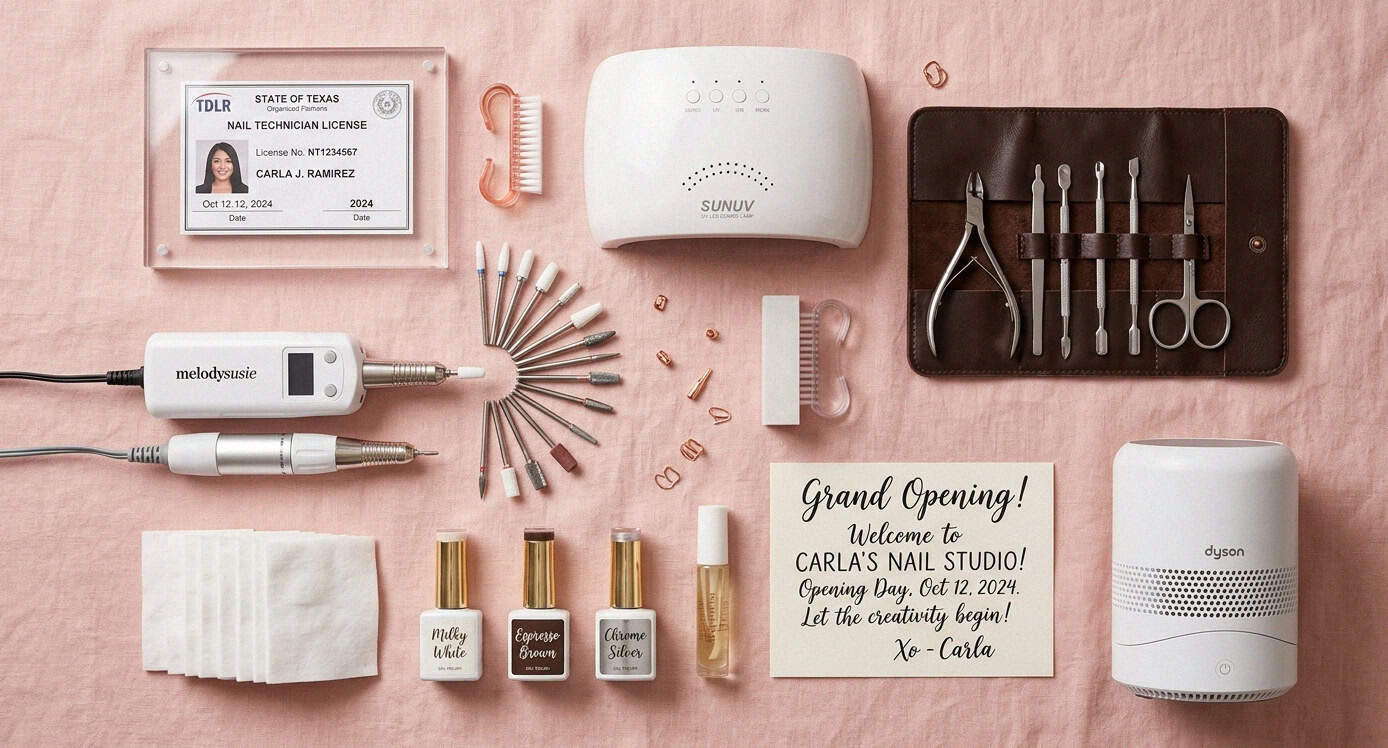
Starting a nail tech business in Texas requires a Cosmetology - Nail Technology license from TDLR, the Texas Department of Licensing and Regulation. That license is the legal prerequisite before you can charge for any nail service, anywhere in the state. Earning it means completing 600 hours of training at a TDLR-licensed cosmetology school, then passing a two-part licensing exam administered by PSI. The TDLR application fee is $50, and the license is valid for two years.
Once you are licensed, three workspace paths are available: booth rental inside an existing nail salon, a private nail suite in a suite rental facility, or a home-based studio. Each carries a different cost structure and a different income ceiling. Independent nail techs in Frisco who rent their own suites keep 100% of their service revenue and set their own hours, prices, and service menus.
Frisco is one of the strongest markets in North Texas for nail services. The city’s population growth, above-average household income, and concentration of working professionals in the North Dallas corridor create steady demand for appointment-based beauty services. A nail tech who gets licensed, selects the right workspace, and builds a consistent clientele has a clear path to a profitable independent practice in this market.
This guide covers every step: Texas nail tech licensing requirements through TDLR, choosing a business structure, comparing your workspace options, reading the Frisco market, and building a client base from scratch.
Last verified: March 2026. Check tdlr.texas.gov for current requirements before acting on any figures here.
TDLR, the Texas Department of Licensing and Regulation, is the state agency that licenses nail technicians in Texas. The official license category is Cosmetology - Nail Technology, and it is the legal requirement before you can perform nail services for compensation. This applies regardless of where you work: a traditional nail salon, a booth rental arrangement, or your own independent suite. The license belongs to you as an individual, not to any business entity you form.
Texas requires 600 hours of instruction at a TDLR-licensed barbering or cosmetology school. To enroll, you must be at least 17 years old and hold a high school diploma or GED.
The 600-hour curriculum covers nail anatomy and physiology, sanitation and sterilization procedures, manicures and pedicures, nail enhancements (acrylic, gel, and dip powder systems), and nail artistry. Schools vary in how much time they dedicate to advanced techniques such as gel extensions and acrylic application. If you plan to specialize in nail enhancements, ask prospective schools specifically how many hours the curriculum allocates to those techniques before you enroll.
Most students complete 600 hours in four to six months on a full-time schedule. Part-time students typically finish in eight to twelve months. Factor in time after graduation for the exam and application process. Most candidates move from school enrollment to licensed status within six to nine months total.
Texas also offers a Cosmetology - Manicurist/Esthetician combination license. That credential requires either an 800-hour combined program or completion of both the 600-hour nail technology program and a 750-hour esthetics program separately. If adding skin care services to your business interests you, the combination license is worth evaluating before you commit to a school and schedule.
After your school verifies your completed hours, TDLR confirms your eligibility and PSI, the state’s licensed exam provider, sends you a scheduling notice. You must pass both exam components before submitting your license application.
The written exam covers Texas cosmetology law, sanitation and sterilization standards, nail anatomy, and safety procedures. The PSI practical exam requires a hands-on demonstration that includes sanitation protocols, polish application, and nail enhancement techniques. Both components must be passed before TDLR will process your license application.
A note on criminal history: TDLR conducts a background check on all applicants. Most prior convictions are reviewed case-by-case, and that review can take one to six months depending on the circumstances. If you have a criminal history, TDLR’s website provides a pre-determination request process you can use before enrolling in school.
Before You Enroll
If you have any prior convictions, request a TDLR pre-determination review before paying school tuition. Submit your criminal history online and TDLR will give you a preliminary decision on likely eligibility. School costs several thousand dollars. Knowing your status first takes two minutes and costs nothing.
The TDLR application fee is $50, non-refundable, submitted online or by mail. PSI charges separate exam fees.
School tuition is the largest cost in the licensing path and varies significantly by program and location. A realistic all-in estimate for licensing, including school tuition, supply kit, exam fees, and the TDLR application fee, typically runs several thousand dollars. A practical first-year budget for an independent nail tech, covering licensing, workspace, equipment, and initial product inventory, generally falls in the $10,000 to $20,000 range depending on the suite or workspace you choose.
Your Texas Cosmetology - Nail Technology license renews every two years. Each renewal cycle requires eight hours of continuing education, which can be completed through TDLR-approved providers.
Most nail techs who go independent never think about business structure until they already have clients. That is a mistake worth correcting before your first appointment, because your choice determines your personal liability exposure from day one.
A sole proprietorship is the default business structure when you start working independently without registering a formal business entity. No registration is required beyond a DBA, or “doing business as” filing, if you operate under a business name other than your own legal name. Your business income and expenses are reported on Schedule C when you file your personal federal tax return.
The simplicity is genuine. The exposure is also genuine. In a sole proprietorship, there is no legal separation between your personal finances and your business finances. If a client experiences an allergic reaction to a nail product, slips in your suite, or files a dispute against you, your personal assets are part of that equation.
An LLC, or Limited Liability Company, creates a legal separation between you as an individual and your business. Liability exposure is generally limited to business assets rather than personal ones. Forming an LLC in Texas requires a Certificate of Formation filed with the Texas Secretary of State. The state filing fee is $300. You will also have annual franchise tax reporting obligations.
One distinction that matters for nail techs specifically: your TDLR Cosmetology - Nail Technology license is issued to you as an individual, not to your LLC or any other business entity. The LLC handles liability protection and financial separation. The license belongs to you personally, regardless of how your business is structured.
Sole Proprietorship vs. LLC: Quick Comparison
| Sole Proprietorship | LLC | |
|---|---|---|
| Setup Cost | Minimal (DBA filing if needed) | ~$300 filing fee + annual reporting |
| Liability Protection | None | Personal assets separated from business |
| Tax Treatment | Schedule C, personal return | Pass-through to personal return (default) |
| Formal Registration | Not required | Required (TX Secretary of State) |
| Best For | Early testing, very low volume | Any nail tech seeing clients regularly |
Many nail techs launch as sole proprietors and convert to an LLC once they have consistent revenue. That path is reasonable. What is not reasonable is waiting too long, because liability exposure begins with your first paying client.
Professional liability insurance is worth carrying regardless of which structure you choose. An LLC and liability insurance together provide more protection than either one alone. Consult a licensed CPA or attorney before making the final call; the right structure depends on your specific financial situation.
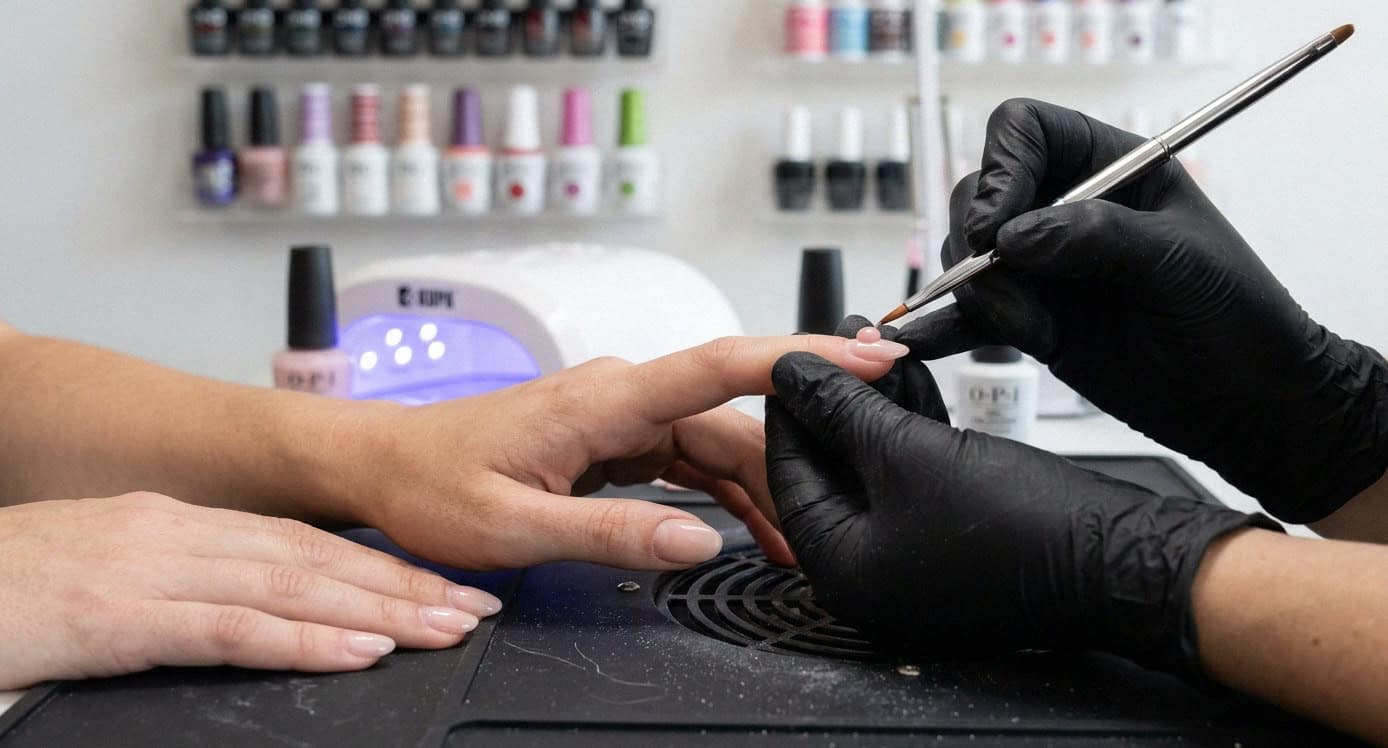
Once your Texas nail tech license is in hand, your workspace decision shapes nearly everything else: your income ceiling, your independence, your client experience, and your startup costs. Three real options exist for licensed nail technicians in Texas.
Booth rental means paying a weekly or monthly station fee to use a workstation inside someone else’s nail salon. The salon owner typically handles front desk operations, provides some shared amenities, and sometimes supplies products.
Booth rental excels at giving new techs built-in foot traffic. A nail tech without an existing client base can benefit from walk-ins and the salon’s established clientele. Booth rental lags on independence: you are operating inside someone else’s brand, the salon owner sets certain rules, your schedule may be tied to salon hours, and your ability to differentiate your services and pricing is limited.
A private nail suite is a fully enclosed, independently rented space within a salon suite facility. You have your own door, your own room, and complete control over everything inside: your hours, your pricing, your product selections, your decor, and your client experience.
Venus Salon Suites Frisco has suites starting at $250 per week, all-inclusive, covering utilities, high-speed WiFi, building maintenance, and 24/7 secure access. introductory rate of $150 per week for the first 8 weeks.
Ventilation is a meaningful consideration when evaluating nail suites. Chemical exposure from acrylic monomer and gel products requires adequate air exchange in the suite. Before signing with any suite facility, ask specifically about ventilation in the spaces designated for nail services.
What to Ask Before Signing
When evaluating a nail suite, ask these questions before signing anything:
The revenue comparison between booth rental and suite rental is direct. Commission-based employment in a traditional nail salon typically returns 40 to 60 percent of service revenue to the tech. In a private suite, you retain 100 percent of your service and retail revenue. Your fixed cost is the weekly suite rate. Everything above that is yours.
For a full breakdown of what goes into equipping a nail suite from scratch, see our guide to setting up a nail suite from scratch.
For a detailed cost comparison across Frisco suite options, see what a salon suite rental costs in Frisco.
Texas permits licensed cosmetology professionals to operate from a home-based salon, but this requires a separate home-based salon license from TDLR in addition to your individual Cosmetology - Nail Technology license.
Overhead is the main advantage. Practical limitations are significant. Home-based nail businesses face zoning restrictions (check friscotexas.gov for Frisco’s current rules on home-based salon operations), limited client parking, and a client experience that is harder to control than a professional suite environment. Scaling past a certain appointment volume also becomes difficult when your workspace is inside your residence.
For most nail techs, the home studio works as an entry point or a low-volume side operation. It is rarely a sustainable long-term platform for growth.
Workspace Options: Side-by-Side
| Booth Rental | Private Suite | Home Studio | |
|---|---|---|---|
| Weekly Cost | Lower (station fee) | Higher (suite rate) | Lowest (overhead only) |
| Independence | Partial | Full | Full |
| Client Control | Limited | Complete | Complete |
| Revenue Retention | 40-60% of service revenue | 100% | 100% |
| Ventilation Control | Salon-managed | Suite-level | Self-managed |
| Best For | Building initial clientele | Established or growth-stage | Starting out, low volume |
If you are ready to see available suites at Venus Salon Suites Frisco, call (972) 369-1127 or visit venussalonsfrisco.com/contact/ to schedule a tour.
Frisco is one of the fastest-growing cities in Texas. The population has passed 200,000 residents and household income runs well above the state and national averages. That income level shapes the local service economy in ways that directly benefit independent nail techs: clients in this market support regular appointments, prefer private professional environments, and are more likely to book recurring services rather than walk-in single visits.
The core demographic in the Frisco and North Dallas corridor, dual-income households, young families, and professionals commuting to major employment centers in Plano, Allen, and the Legacy West district, creates stable recurring demand for nail services. Gel polish and acrylic enhancements require rebooking every two to four weeks. For a nail tech running a full appointment schedule, that rebooking cycle produces predictable, repeating revenue from the same client base.
Frisco’s calendar also generates seasonal demand spikes that a prepared nail tech can plan around: prom season in spring, the summer stretch, and the holiday run from October through December. Structuring your service menu around those cycles helps keep your appointment book full during slower weeks.
One advantage specific to a suite facility like Venus Salon Suites Frisco at 15922 Eldorado Pkwy is placement within a community of 30-plus independent beauty and wellness professionals. Hair stylists, estheticians, massage therapists, lash specialists, and barbers working in the same building create a natural cross-referral network. A hair client who asks her stylist for a nail tech recommendation becomes a warm referral with no marketing cost. That kind of peer referral is difficult to replicate when working alone in a home studio or as a single booth tenant in a single-specialty salon.

Going independent is primarily a client acquisition challenge, not a skills challenge. Most nail techs who stall after leaving a commission salon did not lose technical ability. They underestimated how intentional the business development side needs to be. The five strategies below are practical, low-cost, and compound over time.
Pro Tip
A simple script makes rebooking easier: "Your next fill will be due in about three weeks. Want to grab a spot now while I have you here?" Most clients say yes. The ones who do not were going to fall off the schedule anyway. Rebooking at checkout is not pushiness; it is doing your client a favor by keeping them on schedule.
1. Build your social media portfolio before you open. Nail services are highly visual. Before you even have your suite, post consistently on visual platforms. Before-and-after photos, process videos, and finished nail sets constitute your most effective marketing material. The goal is an active portfolio and a waiting list before your first official day.
For a full breakdown of which platforms produce the best results and how to structure posts that convert browsers into bookings, see our guide on using social media to grow a nail clientele.
2. Set up a structured referral program. A referral offer, such as a complimentary add-on service for every new client referred by an existing one, gives your current clients a concrete reason to mention you. Word of mouth already drives a significant share of new business for nail techs. A structured referral system accelerates it without requiring any paid advertising. Our guide to building a referral program for nail clients covers how to design one that rewards clients without discounting your core service pricing.
3. Use cross-referrals within your suite community. Working in a suite facility alongside other beauty professionals is a client acquisition asset. Build relationships with the other tenants. Hair stylists, estheticians, and massage therapists all serve clients who also need nail services. That cross-referral network is one of the fastest paths to a full appointment book when you are in a new location.
4. Claim and build out your Google Business Profile. A nail tech in a private suite can list their business independently on Google Maps, separate from the suite facility itself. Fill out your profile completely, add photos regularly, and collect reviews from satisfied clients after every appointment. Before-and-after nail images perform especially well in local search results for nail services in Frisco.
5. Rebook at checkout, every time. The most effective client retention tactic is also the most often skipped. Gel services rebook in two to four weeks. Acrylics rebook in three to four weeks. If you do not offer the next appointment before the client leaves, you are leaving rebooking to chance. A full appointment book built on proactive rebooking is significantly more stable than one built on constant new client acquisition.
Startup cost depends primarily on your workspace choice. Your TDLR Cosmetology - Nail Technology license requires the school tuition for 600 hours of training, plus the $50 TDLR application fee and PSI exam fees . If you rent a private suite, budget for the weekly rate plus initial equipment and product inventory. A realistic first-year budget for an independent nail tech typically falls between $10,000 and $20,000 depending on workspace costs and how you equip your space.
Yes. Texas requires a Cosmetology - Nail Technology license from TDLR before you can legally perform nail services for compensation. You must complete 600 hours of training at a TDLR-licensed school and pass a state licensing exam through PSI. Operating without a license violates the Texas Cosmetology Act and can result in fines or denial of future license applications.
The 600-hour training requirement takes four to six months on a full-time schedule, or eight to twelve months part-time. After completing school, you submit your application to TDLR and schedule your PSI licensing exam. Most candidates complete the full process, from school enrollment to licensed and working, within six to nine months.
Booth rental means paying a station fee inside an existing nail salon, where the salon owner controls certain rules and your brand identity is limited to a shared space. A private nail suite is an enclosed room you rent independently within a suite facility. In your own suite, you control your hours, pricing, product lines, ventilation setup, and the entire client experience. You are operating your own business rather than working inside someone else’s.
Yes, with an active Texas Cosmetology - Nail Technology license from TDLR. Salon suite facilities rent individual spaces directly to licensed professionals. You operate as your own business, set your own schedule, and keep 100% of your service revenue. Rates at Venus Salon Suites Frisco start at $250 per week all-inclusive, with introductory rate of $150 per week for the first 8 weeks.
At minimum: a nail table, client chair, nail tech stool, UV/LED lamp, sanitation station, and adequate ventilation for chemical products such as acrylic monomer and gel systems. You will also need product inventory (polishes, gel systems, acrylic supplies, tools), a booking system, and professional liability insurance. See our full guide to getting your nail suite set up in Frisco.
No, but it is worth considering before you start seeing clients. Most nail techs start as sole proprietors, which requires no formal registration and keeps taxes straightforward with Schedule C reporting. An LLC creates legal separation between your personal finances and your business, which provides meaningful protection if a client dispute or injury claim arises. Consult a licensed CPA or attorney to determine which structure fits your situation.
Getting your Texas nail tech license through TDLR is the foundation. What you build on that foundation is the business.
Frisco’s market conditions, the density of professional clients, the two-to-four-week rebooking cycle on gel and acrylic services, and the cross-referral potential within a suite community all point toward private suite rental as the strongest long-term platform for an independent nail tech in this area. It is not the cheapest starting point, but it is the one with the highest income ceiling and the clearest path to building a business that is fully yours.
Venus Salon Suites Frisco has been supporting independent beauty professionals at 15922 Eldorado Pkwy in Frisco since 2012. Suites start at $250 per week, all-inclusive, with utilities, WiFi, and 24/7 access included. introductory rate of $150 per week for the first 8 weeks You share a building with more than 30 other beauty and wellness professionals, all working independently and all with clients who regularly need nail services.
If you are ready to see available suites or want to walk the space before committing, call (972) 369-1127 or visit venussalonsfrisco.com/contact/ to schedule a tour.
No. Texas requires 600 hours of hands-on training at a physical, TDLR-licensed cosmetology or barbering school. There is no fully online path to the Cosmetology - Nail Technology license. Some schools offer a hybrid format where theory coursework can be completed online, but the practical, hands-on hours must be completed in person. If you see a program advertising a fully online Texas nail tech license, verify its TDLR approval status before enrolling. Training at an unlicensed school will not satisfy TDLR requirements and will disqualify your license application.
Operating as a nail technician without a valid TDLR Cosmetology - Nail Technology license is a violation of the Texas Cosmetology Act. TDLR has enforcement authority and can issue civil penalties. In addition, working unlicensed can result in denial of your license application when you do apply, since TDLR reviews compliance history. Suite facilities and salon owners who knowingly allow unlicensed practitioners to operate can also face penalties. The compliance risk is not worth it, and with a 600-hour program taking as little as four months, the licensed path is shorter than many people assume.
TDLR maintains a public license verification tool at tdlr.texas.gov. You can search by the licensee's name, license number, or business name. The results show the license type, current status (active, expired, suspended), and expiration date. Suite rental facilities and clients use this tool routinely to verify a nail tech's credentials before an appointment or before signing a rental agreement. If you are a nail tech, confirming your own license status is active before you start working is a basic step that takes about two minutes.
Yes, through TDLR's "Apply by Equivalence" process. If you completed nail technology training in another state, TDLR will review your hours and training documentation to determine whether your credentials meet Texas requirements. The key threshold is the 600-hour minimum. If your out-of-state program included fewer hours than Texas requires, you may need to complete additional training at a TDLR-licensed school. The equivalence process does require passing the same PSI written and practical exams as Texas-trained applicants. Full details are on the TDLR website under the equivalency application section.
Not automatically. TDLR conducts a background check on all license applicants, and prior convictions are reviewed on a case-by-case basis. The nature of the offense, how long ago it occurred, and evidence of rehabilitation all factor into the review. TDLR offers a pre-determination review process: before you enroll in school, you can submit your criminal history and request a preliminary decision on whether it is likely to affect your application. This step is worth taking if you have any prior convictions, since school costs several thousand dollars and you want to know your eligibility status before making that investment.
Income depends on your service menu, appointment volume, and pricing. The structural advantage of a private suite is that you keep 100% of service and retail revenue rather than the 40 to 60 percent that commission-based employment returns. A full appointment book of gel and acrylic clients, who typically rebook every two to four weeks, creates a recurring revenue base rather than dependence on walk-in traffic. Frisco's above-average household income and concentration of professional households supports premium pricing on nail services. A realistic range for a full-time independent nail tech in a private suite in this market, once the client base is established, runs from $50,000 to over $80,000 annually, though individual results vary based on hours worked, service mix, and how consistently clients are retained and rebooked.
Texas offers a combination credential that covers both nail technology and esthetics. You can earn it two ways: complete an 800-hour combined Manicurist/Esthetician program at a TDLR-licensed school, or complete the 600-hour nail technology program and the 750-hour esthetics program separately. The combination license allows you to legally perform both nail services and skin care services (facials, chemical peels, waxing) under one credential. For a nail tech who wants to offer a broader service menu and attract clients who book both nail and skin care appointments, the combination license is worth factoring into your school selection decision before you commit to a program length and schedule.